Pickleball Paddles for Beginners: A First-Time Buyer’s Guide
This article contains affiliate links. If you buy through them, we may earn a commission at no extra cost to you.
The best pickleball paddles for beginners make it easier to learn, not harder to choose. You do not need the most expensive paddle or the latest technology to enjoy your first games. A comfortable grip, manageable weight, forgiving hitting area, and predictable response matter more than impressive marketing claims. This guide explains what to look for, where to spend your money, and how to choose a first paddle that suits your needs.
1. What Beginners Actually Need from a Pickleball Paddle
Your first paddle should help you build consistent contact and control the ball. Early on, most mistakes come from timing, positioning, or technique—not from using equipment that lacks premium features.
Look for these four qualities before comparing brands:
- Comfort: The handle should feel secure without requiring you to squeeze hard.
- Manageable weight: You should be able to move the paddle comfortably during quick exchanges.
- Forgiveness: A broad hitting surface can make imperfect contact less punishing.
- Predictability: The paddle should make it reasonably easy to judge how far and fast the ball will travel.
A versatile, control-oriented paddle is usually a sensible starting point. Beginners need to practice serves, returns, volleys, dinks, and softer shots, so an all-around design is more useful than one built around maximum power.
Do not worry about finding a paddle you will use forever. Choose something suitable for learning, then reassess once you understand your preferences.
2. Get the Weight, Grip, and Shape Right
Paddle weight: start with comfortable handling
Many beginners find a midweight paddle manageable. As a starting point, you might compare options around 7.5 to 8.3 ounces, while remembering that there is no ideal weight for everyone.
Lighter paddles can be easier to maneuver, but they may feel less stable against hard shots. Heavier paddles can offer more stability and momentum, yet may be tiring or difficult to position quickly.
Listed weight does not tell the whole story. A paddle with more weight toward its head can feel harder to swing than a similarly weighted paddle with a more balanced design. This is why holding or borrowing a paddle is useful.
Grip size: choose a relaxed, secure hold
A grip that is too large may be difficult to control comfortably. A grip that is too small may encourage unnecessary squeezing. Hand size matters, but so do your preferred grip style and the shape of the handle.
If you are between sizes, a slightly smaller grip can often be built up with an overgrip. Making an oversized grip smaller is generally less straightforward.
- Hold the paddle as you would during play.
- Check whether you can keep it secure with relaxed fingers.
- Make a few gentle swings and changes between forehand and backhand.
- Notice whether the handle feels cramped, slippery, or awkward.
Shape and handle length
Standard and widebody shapes are worth considering because their broader faces can help with off-center contact. Elongated paddles offer extra reach, but their narrower faces may be less forgiving, depending on the design.
A longer handle can suit players who use a two-handed backhand. A shorter handle may work well for someone who prefers a compact paddle and mostly uses one hand. Neither is automatically better for beginners.
3. Understand Materials, Thickness, and Playing Feel
Paddle descriptions can sound technical, but you only need a basic understanding to make a useful comparison. The face, core, thickness, and overall construction work together to determine how a paddle feels.
Common face materials
| Material | General characteristics | Beginner takeaway |
|---|---|---|
| Wood | Often inexpensive, but commonly heavier than modern composite options | Can work for occasional recreation, though less appealing for regular learning |
| Fiberglass or composite | Often associated with a lively response; performance varies by construction | A reasonable option for an affordable first paddle |
| Graphite or carbon fiber | Used across many designs, from accessible models to premium paddles | Potentially useful, but the material label alone does not guarantee control or quality |
Manufacturers sometimes use broad material terms, so avoid treating “carbon” or “composite” as a complete description of performance. A comfortable, well-designed fiberglass paddle can be a better fit than a carbon-fiber paddle with an unsuitable weight or shape.
Core thickness and response
Polymer honeycomb cores are common in modern paddles. Thicker designs often emphasize a softer, more controlled feel, while thinner designs may feel quicker or more lively. These are tendencies, not rules.
If you are comparing 14 mm and 16 mm paddles, do not assume the thicker model is always better. Face materials, weight distribution, and construction can change the result substantially.
Control, power, and spin
Control means being able to place shots and manage pace. Power helps generate speed and depth. Spin depends on both paddle characteristics and your technique.
For a first purchase, prioritize predictable contact over extreme power or advertised spin. A paddle cannot replace learning how to strike the ball cleanly, and a lively face may make soft shots harder to judge.
4. Budget vs Premium: What Should a Beginner Spend?
You do not need a premium paddle to learn pickleball properly. Paying more may bring different construction methods, specialized performance, or refined feel, but it does not automatically make a paddle easier to use.
The practical difference between budget and premium pickleball paddles is often about how specific your needs have become. An experienced player may want a particular combination of stability, power, spin, and maneuverability. A beginner may not yet know which trade-offs matter.
When an affordable paddle makes sense
- You are trying the sport before committing to regular play.
- You need several paddles for a household.
- You want to learn your preferences before making a larger purchase.
- Your budget also needs to cover suitable shoes, balls, or lessons.
When spending more may be worthwhile
A higher-priced paddle can make sense if you have tried it, find it comfortable, and can identify what it does better for you. Buying a more expensive model simply because you expect to improve is less convincing.
Shopping for beginner paddles under $100 is a sensible approach. That budget category can include capable options, although prices and availability vary. Compare individual paddles rather than assuming everything below the limit is equivalent.
Within your budget, prioritize suitable weight, clear specifications, reliable construction, and a useful return policy. Cosmetic extras and a long list of technical terms should come later.
5. How to Compare Your First-Paddle Options
Start with a short list of two or three paddles. Comparing dozens of models makes it easy to lose sight of the features that actually matter.
For each option, record:
- Weight or advertised weight range.
- Grip circumference and handle length.
- Paddle shape and dimensions.
- Face material and core thickness, when provided.
- Return conditions and warranty terms.
- Whether it meets the requirements for your intended play.
Where the JOOLA Essentials fits
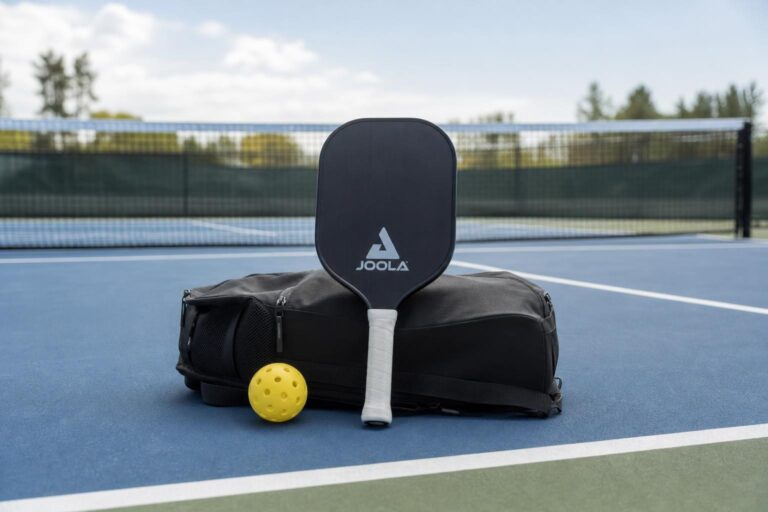
The JOOLA Essentials is one beginner-oriented paddle worth including in an initial comparison. Its fiberglass surface and polymer honeycomb core put it in a familiar entry-level category.
Whether it is a good first paddle for you depends on more than the brand name. Check the specifications of the version or package you are considering, then compare its handling, grip, and price with similar options.
A focused JOOLA Essentials review can help you examine that model more closely, but the broader buying principle remains the same: an accessible paddle is useful only if it fits your hand and playing needs.
Borrow or demo when possible
Borrowing a paddle at an introductory session can reveal preferences that product descriptions cannot. Try gentle dinks, volleys, serves, and returns rather than judging a paddle only by how hard you can hit.
If testing is unavailable, choose a retailer with clear return terms. Check whether using the paddle affects eligibility before taking it onto the court.
6. Buying Beginner Paddle Sets for Couples and Families
A starter set can be convenient when several people are learning together. It may include paddles, balls, and a carrying bag, saving you from buying every item separately.
However, the best beginner pickleball paddle sets are not necessarily the ones with the most accessories. Evaluate the paddles first, then decide whether the extras are useful.
- Check individual paddle weight: A manageable paddle for one adult may feel tiring to another player.
- Consider different hand sizes: Matching paddles do not guarantee suitable grips for everyone.
- Check the included balls: Balls intended for indoor and outdoor conditions have different designs.
- Look beyond the bag: Carrying accessories should not outweigh poor paddle fit.
- Compare separate purchases: Two different paddles may suit a couple better than a matching pair.
For children, pay particular attention to handle size and comfortable handling. Avoid assuming that every adult starter paddle will work well for a smaller player.
A set is especially practical for casual family games. If household members expect to play regularly and have noticeably different needs, buying individual paddles may offer better value.
7. Check Playing Rules and Avoid Common Buying Mistakes
Confirm approval when it matters
If you plan to enter organized competition, check the paddle requirements for that event. Where USA Pickleball approval is required, verify the exact model on the official approved-paddle list rather than relying only on a seller’s description.
Different competitions can use different rules or approval requirements. Recreational venues may also have equipment restrictions, including noise-related policies.
Common beginner mistakes
- Buying for power alone: Extra pace is not helpful if you struggle to keep the ball in play.
- Choosing solely by appearance: Color and graphics do not tell you how comfortably a paddle handles.
- Assuming expensive means forgiving: Some premium paddles are designed for specialized preferences.
- Ignoring handle fit: An uncomfortable grip affects every shot.
- Overvaluing spin claims: Technique remains essential.
- Copying another player’s choice: Their strength, experience, and style may differ from yours.
If you have wrist, elbow, or shoulder discomfort, do not assume a particular paddle will fix it. Equipment comfort matters, but persistent pain deserves appropriate professional advice.
8. Care for Your Paddle and Know When to Upgrade
Basic care helps preserve your first paddle. Keep it out of extreme heat, avoid leaving it in a hot vehicle, and protect it from unnecessary impacts.
Follow the manufacturer’s cleaning instructions. Use only surface-cleaning methods suitable for that paddle, and avoid abrasive products or chemical cleaners unless specifically recommended.
Replace a worn grip or add an appropriate overgrip when the handle becomes slippery. Regularly inspect the edge guard, face, and handle for damage or looseness.
Upgrade for a clear reason
There is no fixed timetable for replacing a beginner paddle. Consider upgrading when you can identify a limitation, such as an uncomfortable grip, excessive swing effort, or a response that no longer suits your developing game.
You may also need a replacement if the paddle is damaged or no longer meets the requirements of your intended competition.
Before buying something new, borrow or demo options that address the specific issue. A change in weight, shape, or handle size may matter more than moving to a higher price bracket.
Conclusion: Start with Fit, Comfort, and Control
The right pickleball paddles for beginners are comfortable, manageable, and predictable—not necessarily expensive. Start with a forgiving shape, a suitable grip, and a weight you can handle easily. Compare affordable individual paddles and starter sets, verify any competition requirements, and try before buying when possible. Once you have played enough to understand your preferences, you will be better equipped to decide whether an upgrade is worthwhile.