Can AI Writing Tools Plagiarize Content?
This article contains affiliate links. If you buy through them, we may earn a commission at no extra cost to you.
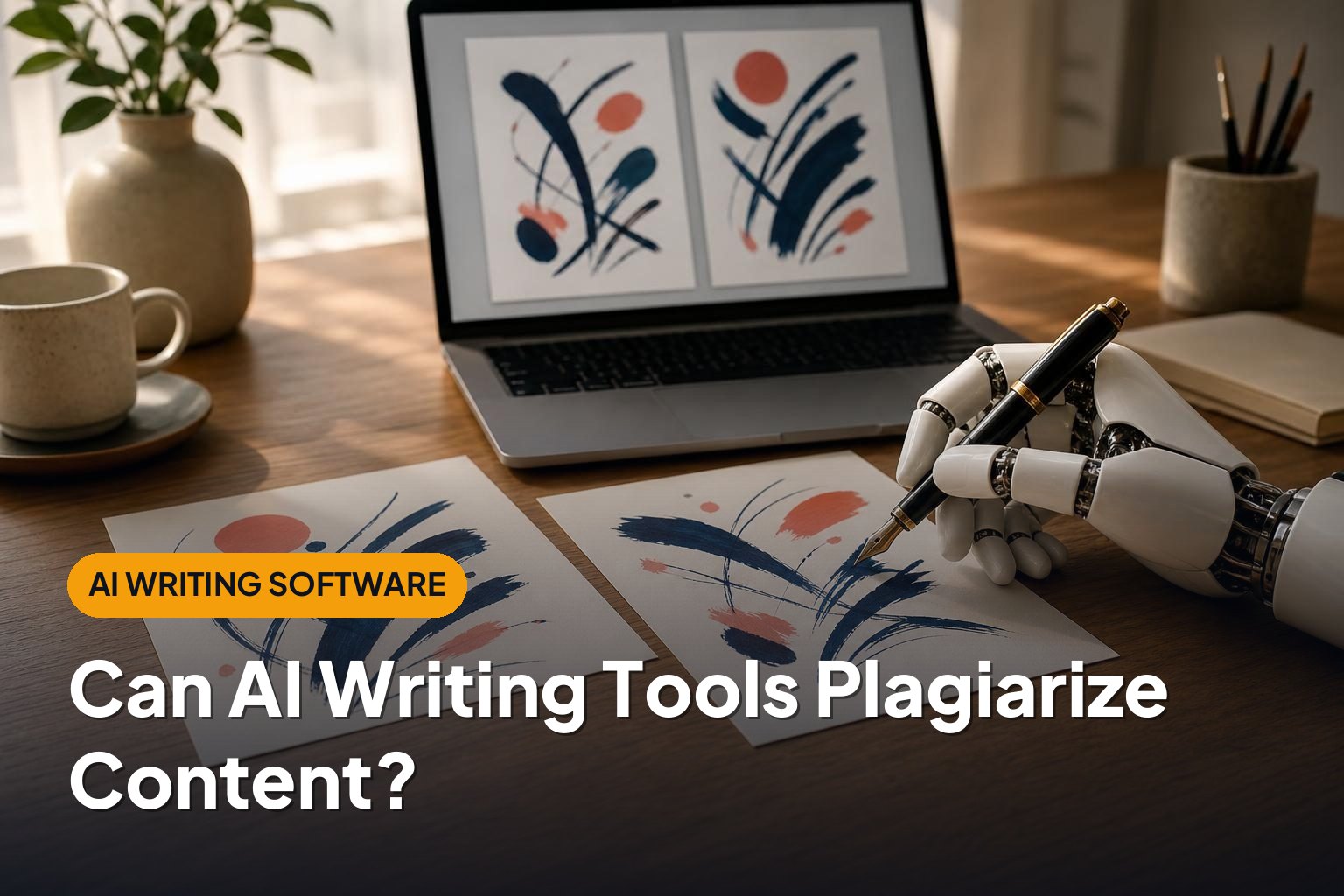
AI writing software can speed up drafting, but it does not guarantee original content. If you are asking “can AI writing tools plagiarize,” the short answer is yes: their output can reproduce existing wording or present someone else’s ideas without proper credit. Understanding the risks helps you use these tools more responsibly.
This article is part of our guide: AI Writing Software: A Guide to Features, Costs, and Content Quality
Frequently Asked Questions About AI Writing and Plagiarism

1. Can AI writing tools plagiarize content?
Yes, AI writing tools can generate content that copies or closely resembles existing material without attribution. This does not mean every AI-generated passage is plagiarized, but it does mean you should not assume an output is original simply because the software generated it.
AI systems generate text using patterns learned during training and information supplied through prompts or connected tools. They do not automatically provide a reliable record of where every statement, phrase, or idea originated.
Potential problems include:
- Reproducing distinctive sentences from an existing source.
- Closely paraphrasing an article while retaining its structure and reasoning.
- Presenting a source’s original ideas without acknowledgment.
- Reusing text supplied in a prompt without making its origin clear.
2. How can AI copy something if it generates new text?
Generating text does not prevent an AI system from reproducing wording it encountered during training or received as input. A newly generated response is not necessarily a completely new expression.
Language models generally produce text based on learned patterns rather than retrieving a stored article for every answer. However, they can sometimes reproduce memorized passages. A tool that searches the web or reads uploaded documents can also incorporate language from those materials.
The prompt matters, too. Asking software to closely rewrite a specific article, imitate a passage, or continue a recognizable text can increase the risk of substantial overlap.
At the same time, matching a common expression is not automatically evidence of plagiarism. Familiar phrases, standard definitions, and routine instructions can appear independently in many places. Context and distinctiveness matter.
3. Is using AI writing software automatically plagiarism?
No, using AI writing software is not automatically plagiarism. The issue is how you use the output, what sources it draws on, and which disclosure or authorship rules apply.
Using AI to brainstorm headings or improve the clarity of your own draft is different from submitting an unreviewed response containing unattributed material.
However, plagiarism is not the only concern. A school may prohibit AI-generated assignments even when the wording does not match any existing source. An employer, client, or publisher may require disclosure or restrict which tools you can use.
Original wording and permitted use are separate questions. Check the relevant policy before treating an AI-assisted document as acceptable work.
4. What is the difference between plagiarism and copyright infringement?
Plagiarism concerns presenting someone else’s words or ideas as your own, while copyright infringement concerns violating legal rights in protected expression. The two can overlap, but they are not interchangeable.
For example, using a source’s original argument without credit may be plagiarism even when you have not copied copyright-protected wording. Conversely, crediting an author does not automatically give you permission to reproduce a substantial portion of their work.
| Issue | Main concern | Does attribution solve it? |
|---|---|---|
| Plagiarism | Misrepresenting the origin of words or ideas. | Proper attribution helps, but copied wording still needs appropriate quotation. |
| Copyright infringement | Using protected expression without a sufficient legal basis. | No. Permission, a license, or a legal exception may also be necessary. |
Copyright rules vary by jurisdiction, and exceptions depend on the circumstances. For consequential publishing or commercial decisions, seek qualified legal advice rather than relying on a writing tool’s assessment.
5. Can a plagiarism checker reliably check AI-generated content?
A plagiarism checker can identify some matching text, but it cannot reliably certify that AI-generated content is plagiarism-free. Its usefulness depends on the sources it can access and the kinds of similarity it can detect.
A checker may flag exact matches and some close paraphrases. It may miss material from private documents, inaccessible publications, unindexed pages, or sources outside its comparison database.
It can also flag harmless overlap, such as common phrases, properly quoted passages, and reference entries. A similarity score therefore needs interpretation rather than an automatic pass-or-fail decision.
Review the matched passages, inspect their sources, and decide whether quotation, attribution, substantial revision, or removal is necessary.
6. Are AI detectors the same as plagiarism checkers?
No, AI detectors estimate whether text may be machine-generated, while plagiarism checkers look for similarities to existing material. They address different questions.
An original AI-generated paragraph may contain no identifiable copied material. A human-written paragraph may be plagiarized. Whether text appears machine-generated does not establish where its wording or ideas came from.
AI-detection results can also be wrong, so they should not be treated as proof of authorship or misconduct.
- To investigate copied wording: compare the passage with potential sources.
- To check attribution: review citations and trace claims to their origins.
- To assess compliance: consult the relevant AI-use policy.
7. Does paraphrasing AI-generated text make it plagiarism-free?
No, paraphrasing AI-generated text does not automatically make it plagiarism-free. Changing the wording does not fix missing attribution for an original idea, argument, or analysis.
Replacing a few words while preserving a source’s distinctive structure can amount to overly close paraphrasing. Asking another AI tool to “humanize” or rewrite the passage does not establish independent authorship either.
A better approach is to locate the underlying source, understand it, and write an explanation that serves your own purpose. Credit the source when its contribution requires acknowledgment.
If the exact wording is important, use a clearly marked quotation and an accurate citation, subject to applicable permissions and rules.
8. Do I need to cite an AI writing tool?
You may need to cite or disclose an AI writing tool, depending on your institution, publisher, employer, or client’s requirements. There is no single rule that applies to every setting.
Some organizations require a formal citation. Others ask for a brief explanation of how the tool assisted with drafting, editing, or research. Some uses may be prohibited altogether.
Disclosing AI assistance does not replace citing the actual sources behind factual claims or borrowed ideas. If a tool summarizes a report, consult and cite that report when possible rather than treating the generated summary as authoritative evidence.
Verify every reference the tool suggests. AI software can produce plausible-looking citations that contain errors or refer to sources that do not exist.
9. How can I reduce the risk of plagiarism when using AI?
You can reduce plagiarism risk by treating AI output as an unverified draft and checking its sources, wording, and attribution before publication. No prompt or software setting can guarantee originality.
- Start with your own outline. Define your audience, argument, and purpose instead of asking for a copy of another article.
- Use trustworthy source material. Keep a record of where facts, quotations, and distinctive ideas originated.
- Request source separation. Ask the tool to distinguish quoted material from summaries, then verify that it has done so correctly.
- Investigate distinctive wording. Search suspicious phrases and compare them with potential originals.
- Run a similarity check. Review individual matches rather than relying only on the overall score.
- Add independent value. Contribute relevant analysis, examples, or explanations instead of merely rephrasing a source.
- Check the final draft. Confirm citations, quotation marks, permissions, and any required AI disclosure.
A prompt such as “make this plagiarism-free” is not a substitute for these steps.
10. Who is responsible if AI-generated content contains plagiarism?
The person or organization submitting or publishing the content generally remains responsible for meeting the applicable originality, attribution, and editorial requirements. Using an AI tool does not automatically transfer that responsibility to its provider.
Legal liability can be more complicated and depends on the facts, contracts, and jurisdiction. A vendor’s terms or protections should not be assumed to cover every use.
If you discover problematic material, pause publication or correct the published version promptly. Check the original source, remove or revise the affected text, and add appropriate attribution where necessary.
For client work or academic submissions, follow the relevant correction and reporting procedures rather than quietly rewriting the passage and assuming the issue is resolved.
Conclusion
AI writing tools can produce plagiarized or overly similar content, but using them is not inherently plagiarism. The safest approach is to verify sources, review suspicious wording, credit borrowed ideas, and follow the rules for your setting. Treat AI as a drafting assistant—not a guarantee of originality.