Best Pickleball Training Aids for Solo Practice
This article contains affiliate links. If you buy through them, we may earn a commission at no extra cost to you.
The best pickleball training aids for solo practice help you get purposeful repetitions when a partner is not available. The right choice depends on whether you want to improve your serve, sharpen your hands, build consistent groundstrokes, or check your technique. These quick picks cover different goals, budgets, and practice spaces.
This article is part of our guide: How to Practice Pickleball: A Guide to Drills, Skills, and Training Equipment
- Best for repeatable shot practice: A pickleball ball machine.
- Best for compact rally practice: A pickleball rebound net.
- Best budget setup: A suitable practice wall with removable targets.
- Best for accuracy and footwork: Flat court targets and markers.
- Best for efficient serving sessions: A ball hopper or pickup tube with extra balls.
- Best for technique feedback: A smartphone tripod and video recording.
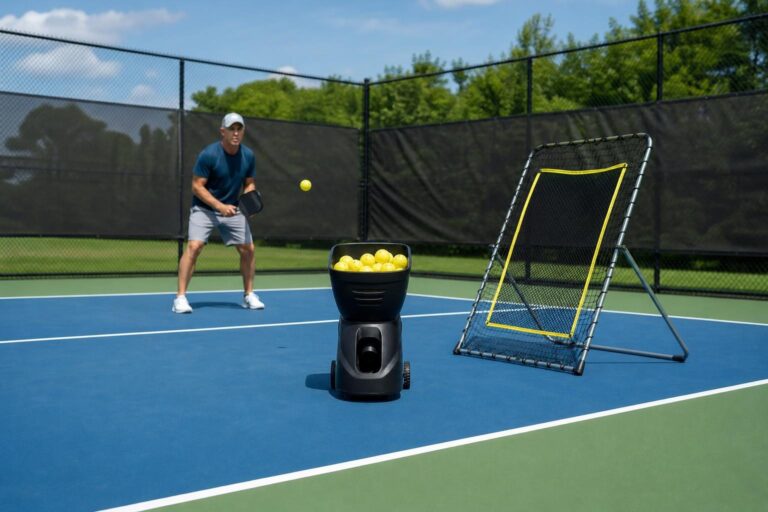
1. Pickleball Ball Machine: Best for Repeatable Shot Practice
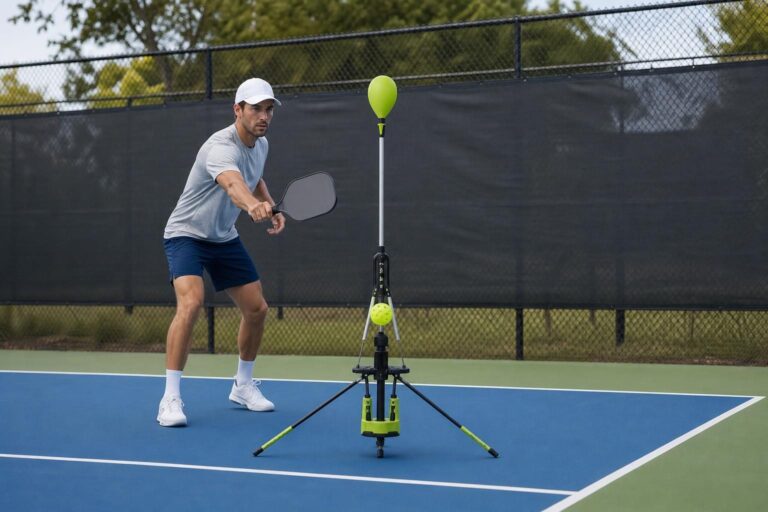
A pickleball ball machine feeds balls without requiring another player. It is the strongest option here for practicing repeated shots from a consistent starting point, especially if you have regular access to an appropriate court.
Depending on its features, a machine can help you work on returns, groundstrokes, volleys, and movement between shots. Some offer adjustable spin, oscillation, or programmable sequences, but those capabilities vary by model.
Strengths
- Repeatable feeds: Work on one technical change without a partner’s changing pace or placement.
- Adjustable difficulty: Suitable machines let you change feed speed, timing, and trajectory.
- Movement practice: Oscillation can add lateral movement instead of letting every shot come directly to you.
Drawbacks
Ball machines generally require the largest investment on this list. They also need transport, storage, a suitable power source, and time for collecting balls. Not every machine can produce realistic soft-game feeds, so check its capabilities if dinks and drops are your priority.
Try this: Set a comfortable feed to your backhand and aim toward a large target area. Practice in short sets, resetting your feet and paddle position after each shot. Add movement only after your contact becomes consistent.
2. Pickleball Rebound Net: Best for Compact Rally Practice
A rebound net sends the ball back after you hit into it, allowing you to practice without repeatedly retrieving every shot. Pick a net specifically intended to rebound pickleballs; a standard court net or ball-catching net will not do the same job.
This aid is especially useful for controlled paddle work, compact swings, and getting comfortable with repeated contact.
Strengths
- Convenient repetitions: Keep a sequence going in a relatively small practice area.
- Portable options: Many designs can be moved or stored between sessions.
- Immediate feedback: An inconsistent strike often produces a noticeably different return.
Drawbacks
The return depends on the net’s tension, angle, and construction. It will not perfectly reproduce an opponent’s shots, and some nets work better for volleys than for bounced-ball drills. You still need enough room for your swing and the ball’s return path.
Try this: Alternate controlled forehand and backhand volleys. Keep your paddle in front and use a compact motion. Focus on balance and clean contact rather than hitting as hard as possible.
3. Practice Wall With Removable Targets: Best Budget Setup
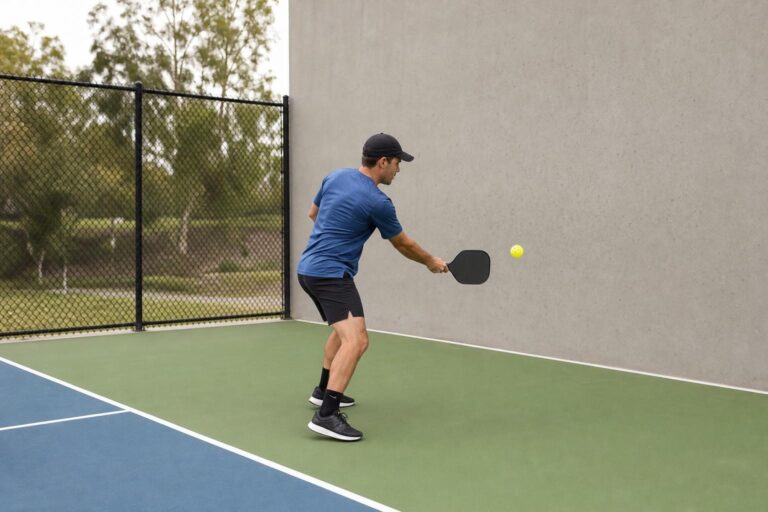
If you have access to a safe, permitted wall, removable tape or suitable target markers can turn it into a useful practice station. A solid, reasonably smooth surface usually gives a more predictable rebound than an uneven one.
Use targets to make wall practice intentional. A marked area gives you something to aim at rather than simply trying to keep the ball moving.
Strengths
- Low equipment requirement: You mainly need a paddle, balls, and a suitable wall.
- Useful for paddle control: Practice compact contact and switching between sides.
- Easy to vary: Change your distance, target size, or permitted number of bounces.
Drawbacks
A wall returns the ball differently from a player, and it can encourage rushed swings if you stand too close. It also cannot show whether a shot would actually land inside the opposite court. Noise, property rules, and the surface behind you may limit where you can practice.
Try this: Mark a generous target and work on controlled shots after one bounce. Start far enough away to prepare comfortably. Treat the target as a consistency reference, not proof that your shots would clear a real net and land in bounds.
4. Flat Court Targets and Markers: Best for Accuracy and Footwork
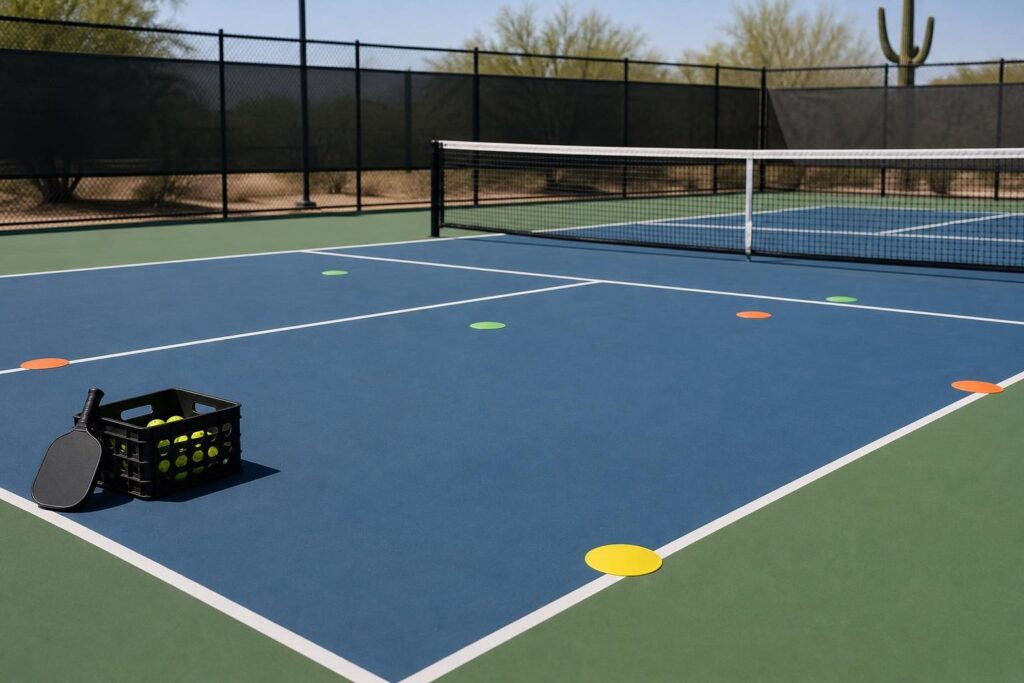
Flat markers help turn an empty court into a structured training space. Use them to define serve zones, return targets, recovery positions, or movement routes.
They are simple, but they solve a common problem: practicing without a clear measure of success.
Strengths
- Clear goals: Aim for a defined area rather than vaguely trying to hit deep.
- Versatile use: Combine them with serves, self-fed shots, or machine practice.
- Easy progression: Start with a large target area and make it smaller as control improves.
Drawbacks
Markers do not supply a ball or provide technical feedback. They can also become slipping or tripping hazards. Choose flat, non-slip options appropriate for the surface, keep them out of landing and running paths, and follow facility rules.
Try this: Define a broad, deep serving zone with a safe margin inside the lines. Hit a set of legal serves, record how many land in the zone, and repeat from the other service position.
5. Ball Hopper or Pickup Tube: Best for Efficient Serving Sessions
A ball hopper or pickup tube makes solo practice less stop-start. Paired with extra pickleballs, it lets you complete a useful serving set before collecting everything.
A hopper can also keep balls within easy reach for self-fed drills. A pickup tube is primarily a collection tool, so consider which task matters most.
Strengths
- Less interruption: Spend more of your session practicing instead of retrieving individual balls.
- Better organization: Keep spare balls together rather than scattered around your feet.
- Simple setup: No charging, programming, or rebound adjustment is required.
Drawbacks
Check that the pickup mechanism is compatible with pickleballs; do not assume every tennis-ball collector will work. Larger baskets also take up storage space, and loose balls on the court remain a safety concern.
Try this: Practice serves in small sets, aiming at the same broad zone. Pause between sets to assess placement, then collect balls before they interfere with your stance or movement.
6. Smartphone Tripod: Best for Technique Feedback
A stable smartphone tripod lets you record your practice and see habits that are difficult to notice while playing. It is particularly useful for checking preparation, balance, contact position, and recovery.
You do not need elaborate editing tools. Short clips reviewed at normal speed and in slow motion can make your next practice set more focused.
Strengths
- Visible feedback: Check whether your movement matches what you intended.
- Progress tracking: Compare the same drill across multiple sessions.
- Works with other aids: Record wall drills, serving practice, or machine-fed shots.
Drawbacks
Video shows what happened, but it does not automatically explain why. Camera angle can also distort your impression of spacing and positioning. Keep the tripod outside playing and retrieval paths, and respect other players’ privacy.
Try this: Record a short serving set from a safe rear-side angle that captures your whole body. Review one feature, such as balance at contact, then film another set after making a small adjustment.
Buying Guide: What to Look for in Solo Pickleball Training Aids
Choose Your Main Practice Goal
Match the purchase to a specific problem. For repeatable incoming balls, consider a machine. For compact contact practice, look at a rebounder or wall setup. For serve placement, targets and extra balls may be all you need.
Measure Your Available Space
Account for your full swing, movement, ball travel, and safe clearance around equipment. A product that physically fits in a garage may still leave too little room for useful practice.
Check Compatibility and Setup Requirements
Confirm ball-machine power requirements, rebounder suitability for pickleballs, collector compatibility, and storage dimensions. For court drills, use balls appropriate to the surface and conditions where you normally play.
Prioritize Feedback Over Features
The most useful aid gives you a clear task and a way to evaluate it. That might mean counting target hits, reviewing video, or maintaining controlled contact. Extra features matter only if they support drills you will actually do.
Conclusion
The best solo practice setup is the one you can use regularly with a clear purpose. Start with a training aid that addresses your biggest need, build a few repeatable drills around it, and add equipment only when it helps you practice more effectively.