Portable Pickleball Net Buying Guide: Size, Stability, and Setup
This article contains affiliate links. If you buy through them, we may earn a commission at no extra cost to you.
A portable pickleball net lets you turn a suitable driveway, shared court, or recreation space into a place to play without permanent posts. But nets that look similar in photos can differ substantially in stability, carrying weight, adjustment, and assembly. This portable pickleball net buying guide explains what matters, which features are worth prioritizing, and how to choose a system that fits both your playing space and your routine.
1. Start With the Right Net Size and Playing Space
Before comparing frames or carrying bags, decide whether you need a regulation-size net or a smaller practice net. That choice affects where you can play, what you can practice, and how much equipment you will carry.
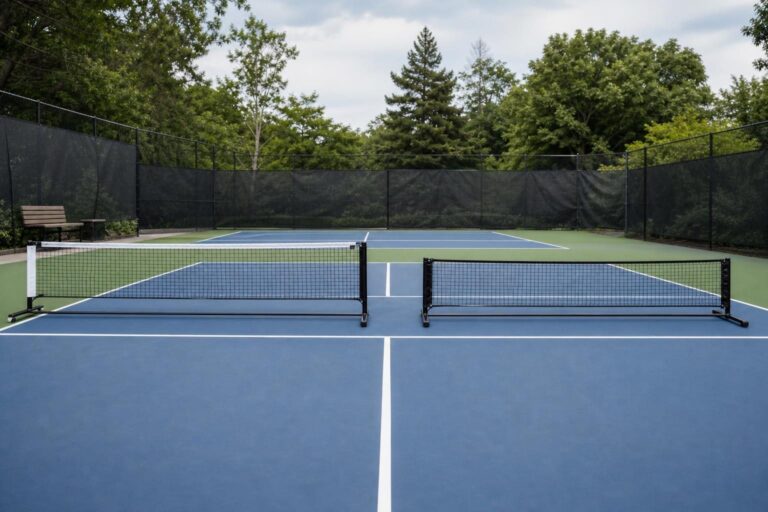
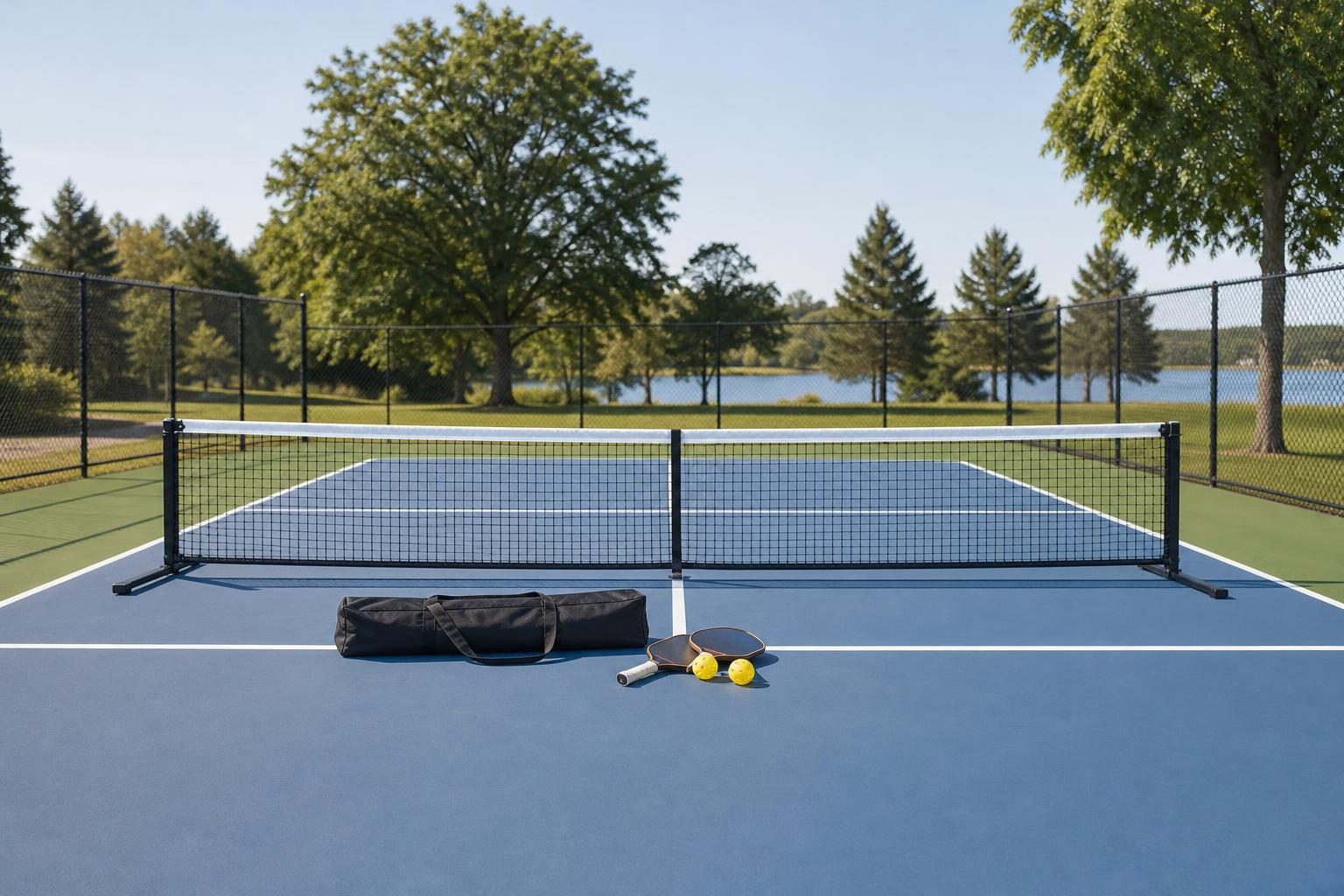
Full-size portable pickleball nets
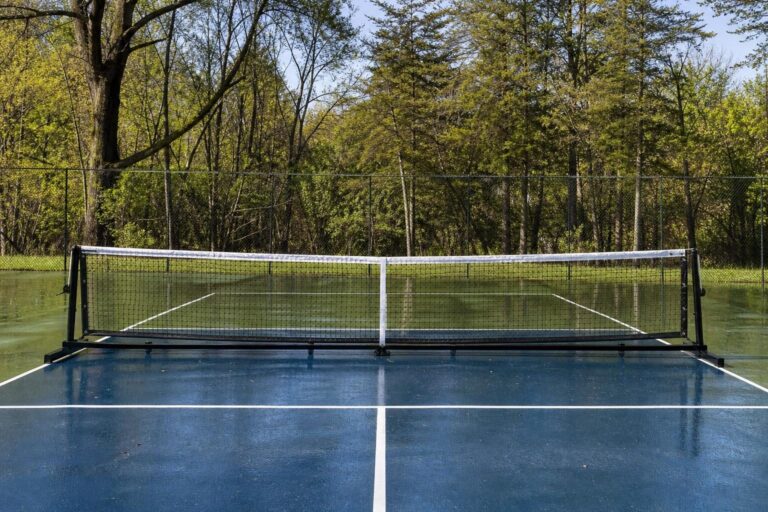
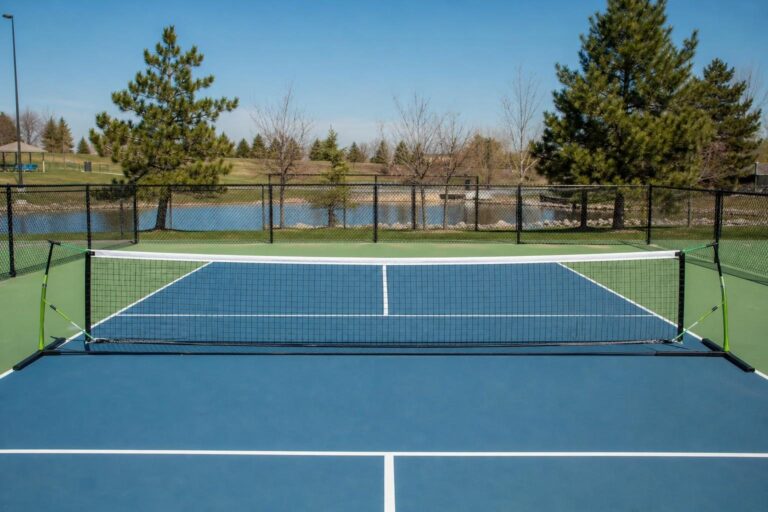
A regulation pickleball net is at least 22 feet wide. Its top should measure 36 inches high at the sidelines and 34 inches at the center. A full-size portable system should let you achieve those heights when properly assembled and adjusted.
The court itself is 20 feet wide and 44 feet long, with the same dimensions used for singles and doubles. The net extends beyond the court’s sidelines, so do not confuse court width with net width.
Also distinguish the marked court from the total space needed to play. You need additional room beyond the baselines and sidelines to move safely. A commonly recommended minimum overall playing area is 30 by 60 feet, with more space preferable when available.
Half-court and compact practice nets
Smaller nets can make sense for a narrow driveway, garage practice area, or compact patio. They are useful for controlled dinking, touch drills, and some one-on-one exercises.
However, “half-court” is not a guarantee of one standardized product size. Check the actual width and height. Some compact nets are designed for pickleball practice, while others are adjustable multisport nets.
- Choose full-size: You want normal singles or doubles play and have adequate surrounding space.
- Choose compact: Your main goal is short-game practice in a restricted area.
- Choose a convertible system: You need different widths and are comfortable storing extra frame sections.
A small net can be a useful training tool, but it does not reproduce the angles, court coverage, or spacing of a full court.
2. Look for Stability, Not Just a Heavy Frame
A good portable net should remain upright and reasonably aligned during ordinary play. Frame weight helps, but the shape of the supports, fit of the joints, and quality of the tensioning system matter too.
Base design and frame connections
Look for feet that create a stable footprint without becoming an unnecessary obstacle. Wide supports can resist rocking, but they also occupy space around the net. Consider where players will walk, especially near the sidelines.
Frame sections should connect securely. Loose joints can allow the system to twist, sag, or feel unstable even when the individual tubes seem sturdy.
A center support helps establish the correct net height on many portable systems. Check how it attaches and whether it sits securely without pushing the center of the net too high.
Net tension and wind resistance
Adjustable straps or other tensioning hardware help keep the top edge at its intended height. A system that is difficult to tension may leave excessive sag or require repeated adjustments.
Do not assume that pulling the net as tight as possible is better. Excessive tension can distort the frame. Follow the manufacturer’s instructions and measure the finished height rather than judging by appearance.
Outdoor wind is another consideration. A portable net is not a permanent installation, and strong gusts can move or overturn it. Use only manufacturer-approved anchoring or ballast arrangements, keep them clear of playing paths, and take the net down when conditions become unsafe.
3. Compare Frame, Netting, and Hardware Quality
Materials influence durability, carrying weight, and maintenance. The best choice depends partly on whether you will use the net indoors, occasionally outside, or several times a week.
Steel versus aluminum frames
| Frame material | Common advantages | What to check |
|---|---|---|
| Steel | Often provides useful weight and rigidity | Overall carrying weight, coating condition, and rust protection |
| Aluminum | Often easier to carry and resistant to red rust | Tube dimensions, joint quality, and resistance to bending |
Material alone does not establish quality. A well-designed steel system may be easier to use than a poorly designed aluminum one, and vice versa. Compare the complete construction rather than relying on a single material claim.
Netting, edge bands, and small components
Look for evenly finished netting, reinforced edges, and stitching that appears consistent in detailed product photos. The mesh should prevent a pickleball from passing through.
Pay attention to the parts that are easiest to overlook:
- Tension straps and buckles: They should be accessible and easy to adjust.
- Center support: Check its construction, attachment method, and replacement availability.
- Feet and end caps: These should suit the intended surface and avoid exposed sharp edges.
- Frame connectors: Secure connections are important for repeated assembly.
- Carrying bag: Strong handles, adequate space, and a practical closure make storage easier.
Replacement parts are especially valuable for frequent users. Being able to replace a damaged net or missing connector can keep an otherwise usable system in service.
4. Understand Setup Before You Buy
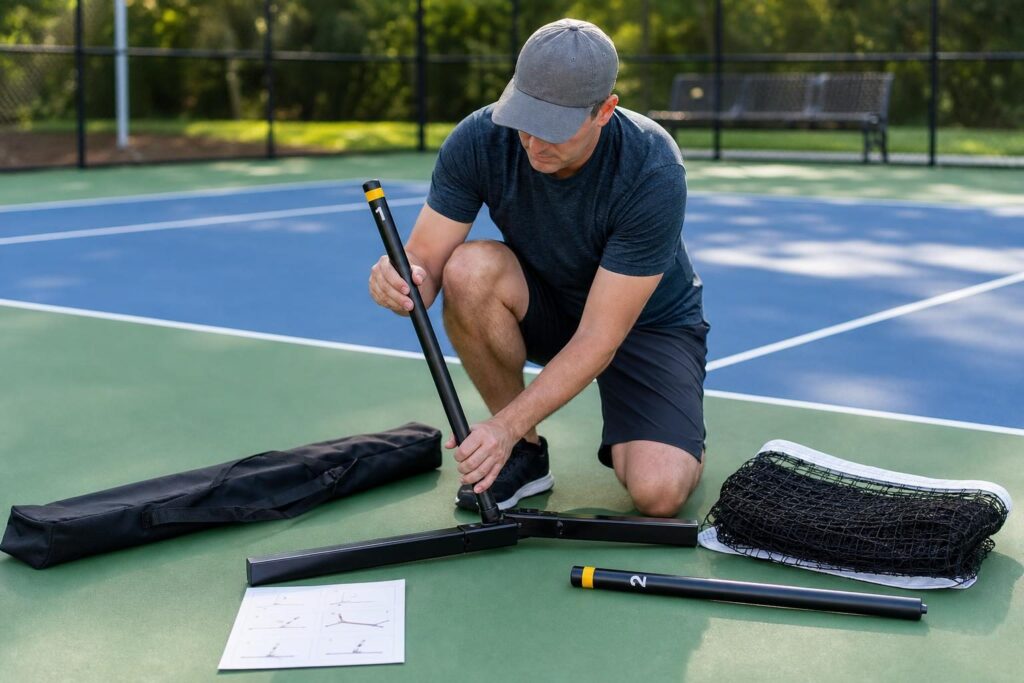
A portable net is only convenient if you are willing to assemble it regularly. Look beyond claims such as “quick setup” and examine the actual process.
Useful features include numbered or color-coded poles, clear instructions, captive connectors, and tool-free assembly. Fewer loose pieces generally mean fewer opportunities to leave something behind.
A typical assembly sequence
- Inspect the surface and lay out the frame components.
- Assemble the base and upright supports according to the instructions.
- Install the net and center support in the specified order.
- Adjust the tension without bending the frame.
- Measure the net at the sidelines and center.
- Check that the feet are stable and all connectors are secure.
Some systems use a different sequence, so the product manual should always take priority. Also check whether one person can manage setup comfortably or whether a second person is recommended.
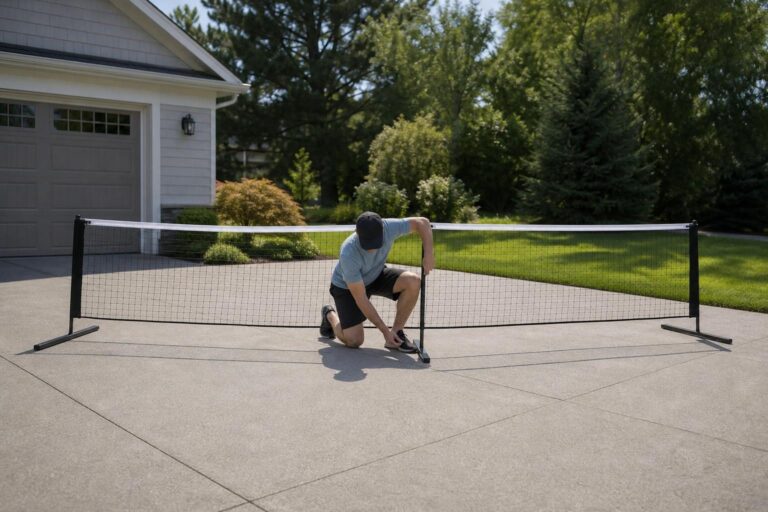
Setting up a net on a driveway
Measure the driveway before ordering. Account for the frame’s feet as well as the net width, and leave room for players to move without entering a street or approaching parked vehicles.
Sweep away gravel, leaves, and other debris. Check for cracks, drainage channels, slippery patches, and substantial slope. A sloping driveway can change ball bounce and make accurate net height harder to achieve; a steep or uneven surface may simply be unsuitable.
Use removable court markings compatible with the surface, with permission where necessary. Position the frame so that supports and any lower crossbar are easy to see. A portable net does not make an unsafe playing area safe.
5. Match Portability and Wheels to Your Routine
“Portable” can mean light enough to carry in a bag, or movable as an assembled unit. Those are different benefits, and the right one depends on where you store and use the net.
For players who transport the net by car
Check the total packed weight and packed dimensions, not just the frame weight. A bag that is awkwardly long may be difficult to fit into a small trunk even if it is relatively light.
Consider the walk from your vehicle to the court. Comfortable handles, a shoulder strap, or a suitable wheeled bag can matter more than a small difference in listed weight.
For shared courts and recreation facilities
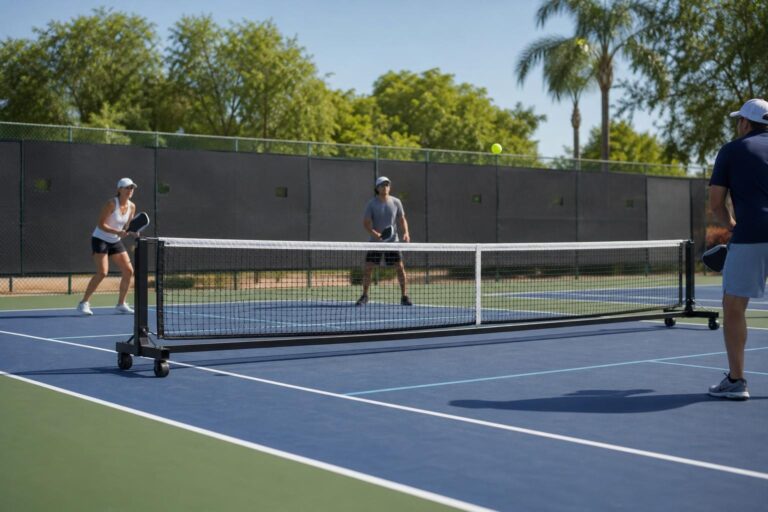
Portable pickleball nets with wheels are useful when staff need to move an assembled system between a storage area and a playing area. They can reduce repeated assembly, particularly in gyms and multipurpose facilities.
Before choosing a wheeled net, check:
- Whether the wheels suit the intended indoor or outdoor surface.
- How the system is secured against rolling during play.
- Whether it fits through storage doors and access routes.
- How it handles thresholds, pavement joints, or uneven ground.
- Whether one person can move it safely according to the instructions.
Wheels do not automatically make a system easier to transport in a vehicle. Some wheeled nets are best treated as movable facility equipment rather than compact travel nets.
6. Choose Features That Justify the Cost
The right purchase is not necessarily the least expensive or the most feature-heavy. It is the net that meets your playing needs without creating unnecessary work.
Priorities for different buyers
- Occasional recreational players: Prioritize correct dimensions, straightforward assembly, and manageable packed weight.
- Frequent outdoor players: Put more emphasis on frame stability, finish quality, and replaceable components.
- Coaches and instructors: Consider repeated setup, transport between locations, and options for compact practice spaces.
- Clubs and facilities: Focus on durability, storage access, wheels where useful, and long-term parts support.
Check what is included in the package. Court markers, balls, and paddles may be convenient, but they should not distract from the quality of the net itself.
How to evaluate a specific system such as PickleNet
The PickleNet Portable Pickleball Net System is one named option to consider alongside other full-size systems. When reading a PickleNet review, focus on the practical questions: Are the components easy to identify? Is tension adjustment straightforward? Does everything fit back into the bag without a struggle?
Apply those same questions to every candidate. Product versions and package contents can change, so verify the current listing and assembly manual rather than assuming every review describes the exact system you are buying.
Finally, check the return policy and warranty terms. Understand what is covered, whether replacement parts are available, and how damage or missing components are handled.
7. Plan for Outdoor Use, Maintenance, and Storage
A net suitable for outdoor play is not necessarily designed to stay outside continuously. Sunlight, rain, moisture, wind, and temperature changes can affect netting, straps, coatings, and connectors.
Can you leave a portable pickleball net outside?
Check the manufacturer’s guidance before leaving it outdoors. Unless the system is specifically designed and approved for ongoing outdoor storage, taking it down after use is the safer approach for preserving its condition.
A cover may reduce exposure, but it does not eliminate moisture or wind risk. A poorly ventilated cover can also trap dampness.
Simple maintenance habits
- Wipe dirt and moisture from the frame after use.
- Let the net and other components dry before packing them away.
- Inspect connectors, straps, stitching, and feet regularly.
- Check steel components for coating damage or developing rust.
- Store the packed system in a dry, sheltered location.
- Replace damaged structural parts rather than improvising repairs.
Keep small removable components together in a pouch if the carrying bag does not provide a dedicated compartment. Before each session, confirm that all parts are present and recheck net height after assembly.
Conclusion: Buy for Your Space and Setup Routine
Start with the space you have, choose the appropriate net size, and then compare stability, assembly, transport, and storage. Correct height and secure construction matter more than a long accessory list.
For most beginners, a manageable full-size system is a versatile choice when space allows. A compact practice net or wheeled facility system can be better when your needs are more specific. Choose the net you can set up safely, maintain easily, and use consistently.