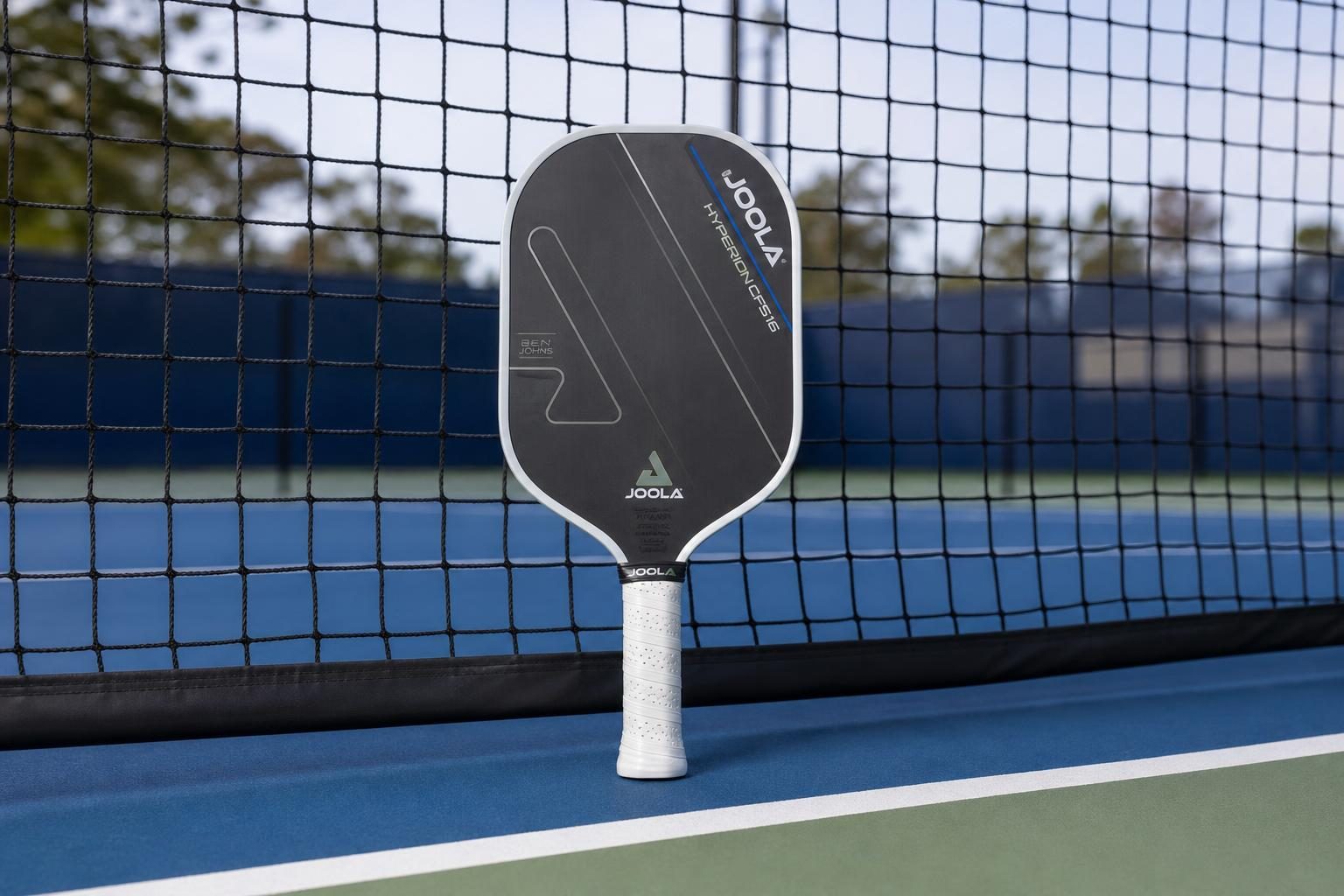
JOOLA Ben Johns Hyperion CFS 16 Review: Who Is It Best For?
This article contains affiliate links. If you buy through them, we may earn a commission at no extra cost to you.
The JOOLA Ben Johns Hyperion CFS 16 is best suited to players who want an elongated paddle with a cushioned feel, useful spin potential, and enough mass to stay steady through contact. Its biggest trade-off is maneuverability: the same substantial feel that helps on blocks and drives can make quick exchanges more demanding. This JOOLA Ben Johns Hyperion CFS 16 review examines its published specifications and construction, explains their practical implications, and identifies who should consider it.
This article is part of our guide: How to Choose a Pickleball Paddle: Materials, Weight, Shape, and Grip
Overview
The original Hyperion CFS 16 is a 16 mm paddle built around a textured carbon hitting surface and a polymer honeycomb core. It belongs to an earlier generation of JOOLA paddles, so it should not be confused with later Hyperion models that use different construction methods and technologies.
Its defining combination is an elongated shape, a relatively substantial listed weight, and a long handle. Together, these favor reach, stability, and two-handed backhands over the quickest possible handling.
| Specification | Published specification |
|---|---|
| Paddle length | 16.5 inches |
| Paddle width | 7.5 inches |
| Core thickness | 16 mm |
| Handle length | 5.5 inches |
| Listed average weight | 8.4 ounces |
| Hitting surface | Carbon Friction Surface |
| Core | Reactive Polymer Honeycomb |
Individual paddle weights can vary. More importantly, static weight does not tell the whole story: how that weight is distributed affects how demanding a paddle feels during swings and rapid changes of direction.
Who It Suits
Intermediate players building a controlled, all-court game
The Hyperion CFS 16 makes sense for players who want to combine patient kitchen play with confident drives and counters. Its thick core and substantial construction favor a composed response rather than an exceptionally lively, springy one.
That does not mean every drop will land softly or every reset will be easy. Paddle-face control, grip pressure, and contact quality still matter. However, players who dislike the sharp response of thinner, stiffer paddles may appreciate this design.
Players who value stability over maximum hand speed
A heavier paddle can resist twisting and recoil at impact, helping it feel more solid when blocking pace. That is particularly useful for players who prefer compact, controlled counters rather than large swings at the kitchen line.
The compromise is that recovering between shots can require more effort. Players who already feel late in hands battles should be cautious about choosing the Hyperion solely for its stability.
Two-handed backhand players
The 5.5-inch handle provides more room for a second hand than many short-handled paddles. Combined with the elongated face, it is a sensible layout for players who use two hands on backhand drives, returns, or counters.
Who should look elsewhere?
- Players prioritizing effortless maneuverability: A lighter paddle or a shorter hybrid shape may be easier to position quickly.
- Players sensitive to arm fatigue: The weight and leverage of an elongated paddle may become tiring over longer sessions.
- Players seeking maximum easy power: Some newer power-oriented constructions deliver a more explosive response with a compact swing.
- Beginners without established preferences: A more neutral, forgiving shape may be a simpler starting point.
Key Features
Carbon Friction Surface
The CFS name refers to JOOLA’s Carbon Friction Surface. Its textured carbon face is intended to help the paddle grip the ball, making it relevant for topspin drives, dipping passing shots, and sliced returns.
Spin potential is useful, but it is not automatic. Swing path and paddle-face angle determine whether that surface helps you produce a controlled ball. Surface condition also matters, especially when buying a used paddle.
There is no need to assume the Hyperion leads every newer paddle in spin. Its more useful selling point is the combination of a textured face with a stable, relatively controlled platform.
16 mm Reactive Polymer Honeycomb Core
The 16 mm core contributes to the paddle’s cushioned, control-oriented character. Compared with thinner, livelier designs, this type of construction generally favors managing pace and placing the ball rather than maximizing immediate rebound.
Still, thickness alone cannot predict performance. Face materials, internal construction, weight distribution, and impact location all influence how a paddle behaves.
Hyperfoam Edge Wall
JOOLA uses foam around the perimeter of the core, which it calls Hyperfoam Edge Wall. The design is intended to improve stability and support performance away from the center of the face.
That is helpful in principle for blocks and imperfect contact, but it does not eliminate mishits. An elongated face remains narrower than a typical widebody paddle, so players who frequently miss toward the side edges may prefer a broader shape.
Elongated Shape and Aero-Curve Profile
The 16.5-inch length gives the Hyperion useful reach on volleys and stretched defensive shots. Its Aero-Curve top profile is designed to reduce drag during the swing.
However, an aerodynamic profile does not cancel out mass or leverage. Players should not assume that the curved top makes this a particularly quick paddle in fast exchanges.
Carbon-Forged Handle
The carbon-forged handle is another named construction feature. For most buyers, the more practical considerations are its length, grip comfort, and how naturally the paddle transitions between forehand and backhand positions.
If possible, hold or demo the paddle before buying. Handle comfort and balance are difficult to judge from a specification sheet.
Pros
- Solid, stable feel: Its substantial build suits players who want reassurance when meeting incoming pace.
- Useful control-oriented response: The thick core makes it a logical option for players who prioritize placement and pace management.
- Textured carbon hitting surface: Supports spin-based shotmaking when paired with appropriate technique.
- Good reach: The elongated format helps on stretched volleys and defensive contacts.
- Room for two hands: The long handle accommodates many two-handed backhand grips.
- Versatile playing profile: It can support both patient kitchen exchanges and more assertive baseline play.
Cons
- Substantial weight: The listed average of 8.4 ounces may be demanding for players accustomed to lighter paddles.
- Less effortless maneuverability: Its elongated shape and weight can make rapid repositioning more difficult.
- Not the most explosive option: Players seeking easy finishing power may prefer a more power-focused design.
- Narrower than widebody alternatives: The shape may be less reassuring for players whose misses tend to occur toward the sides.
- Older construction faces strong competition: Its value depends heavily on the actual selling price and condition.
- Used examples require inspection: Surface wear, edge damage, and changes in sound or response deserve attention.
Alternatives Worth Considering
Vatic Pro PRISM Flash 16 mm
The PRISM Flash 16 mm is worth considering if you like a control-first approach but want a shorter, hybrid-shaped alternative. Its shape offers a different balance of reach and maneuverability from the elongated Hyperion.
It is a particularly relevant comparison for players who are concerned that the JOOLA may feel cumbersome. Check individual weight options rather than assuming every example will feel equally quick.
Selkirk VANGUARD Control Invikta
The VANGUARD Control Invikta is another elongated option aimed at controlled play. It deserves consideration if reach and a textured carbon face appeal to you, but you want to compare a different handle feel and overall balance.
Choosing between them is less about finding a universal winner and more about identifying which paddle feels easier to repeat good contact with.
JOOLA Hyperion C2 16
The Hyperion C2 16 is a useful comparison for players who like the Hyperion shape but want a later construction approach. It uses JOOLA’s Charged Carbon Surface and should be evaluated as a distinct paddle, not simply the original CFS 16 with updated cosmetics.
If you are shopping across generations, confirm the exact model name. Listings that shorten everything to “Hyperion 16” can obscure meaningful differences.
Verdict
The JOOLA Ben Johns Hyperion CFS 16 is best for players who prioritize stability, reach, and a controlled response and are comfortable swinging a relatively substantial paddle. It is especially worth considering for intermediate players and two-handed backhand users.
It is less convincing for anyone seeking the fastest handling or the most effortless power. Compare its actual price with newer alternatives, inspect used examples carefully, and check the exact model’s approval status with your competition’s governing body if tournament eligibility matters. Above all, choose it because its balance suits your game—not simply because it carries a famous name.