Best Portable Pickleball Nets for Driveways and Shared Courts
This article contains affiliate links. If you buy through them, we may earn a commission at no extra cost to you.
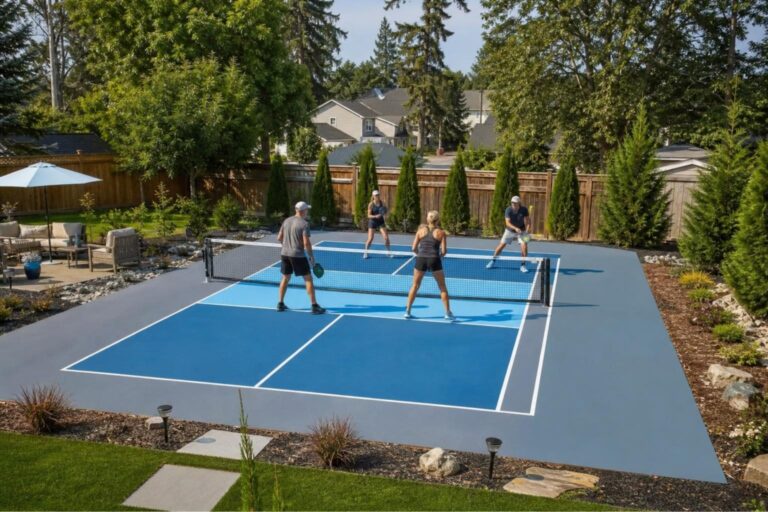
The best portable pickleball nets make it easier to turn a suitable driveway or shared court into a place to play. These five picks cover different priorities, from easy transport to budget-conscious recreational use. Choose a full-size version for standard doubles play, and check the exact package before ordering because accessories and frame designs can vary.
This article is part of our guide: Home Pickleball Court Setup Guide: Space, Surfaces, Nets, and Balls
- Best for frequent transport: SwiftNet Portable Pickleball Net System. A lightweight option worth considering when carrying and storage matter most.
- Best all-around traditional system: PickleNet Portable Net System. A practical choice for players who want a familiar, freestanding setup.
- Best for straightforward recreational play: ONIX Portable Pickleball Net. A conventional portable system for driveway sessions and shared courts.
- Best for budget-conscious shoppers: Franklin Sports Portable Pickleball Net. A useful range to compare when occasional play matters more than premium construction.
- Best for a simple shared-court setup: JOOLA Essentials Pickleball Net. A full-size portable option for groups that need to set up, play, and pack away.
SwiftNet Portable Pickleball Net System: Best for Frequent Transport
SwiftNet is a strong candidate for players who regularly carry their equipment between home, a vehicle, and a public court. Its lightweight frame construction distinguishes it from the steel-frame systems commonly used for recreational play.
It is especially appealing if a heavy carrying bag would discourage you from playing. That advantage matters on shared courts where you cannot leave equipment assembled overnight.
Strengths
- Transport-friendly construction: A good fit for players who prioritize manageable carrying weight.
- Purpose-built tensioning: Its design focuses on maintaining net shape without relying on a conventional heavy steel frame.
- Useful for regular setup and teardown: Worth considering when portability is a recurring need rather than an occasional convenience.
Drawbacks
- Premium positioning: It may be difficult to justify for a household that only plays a few times each season.
- A different assembly process: Players accustomed to basic interlocking steel frames should read the instructions rather than assume everything connects the same way.
- Still needs sensible weather precautions: Lightweight equipment should not be treated as windproof.
Best fit: Regular players who value easier carrying enough to consider a premium portable system.
PickleNet Portable Net System: Best All-Around Traditional System
PickleNet is a familiar option in the portable-net category. Its freestanding frame and center support make it a straightforward choice for players who want a conventional full-court setup without installing permanent posts.
For a driveway or multipurpose hard court, this style offers a useful balance: it is substantial enough for organized recreational play but can still be disassembled for storage.
Strengths
- Conventional layout: A sensible option for groups familiar with portable court equipment.
- Center support: Helps establish the lower net height required at the middle of a pickleball court.
- Versatile use: Suitable for temporary setups on an appropriately sized, reasonably level hard surface.
Drawbacks
- More to carry than lightweight alternatives: A traditional frame can feel cumbersome when the parking area is far from the court.
- Assembly takes organization: Keeping frame sections together and following the setup sequence makes the process easier.
- Ground-level hardware: Players should remain aware of support feet and frame components near the net.
Best fit: Households, clubs, and casual groups that want a dependable traditional format rather than the lightest possible system.
ONIX Portable Pickleball Net: Best for Straightforward Recreational Play
The ONIX portable net is worth considering for players who want a recognizable pickleball brand and a conventional temporary setup. It suits the basic task well: creating a playable net on a suitable surface, then packing it away afterward.
For driveway use, its appeal is simplicity. Rather than shopping for specialized features, you can focus on whether the full-size package meets your carrying, storage, and setup needs.
Strengths
- Recreation-focused format: A practical option for family games, practice sessions, and casual doubles.
- Freestanding setup: No permanent post installation is needed.
- Pack-away convenience: Appropriate for spaces that must return to parking or another activity after play.
Drawbacks
- Not a permanent outdoor installation: Regular exposure to rain and moisture is best avoided.
- Carrying bulk: Check packed dimensions and total weight rather than judging portability from product photos.
- Surface limitations remain: The frame cannot correct a sloping driveway or uneven pavement.
Best fit: Recreational players who want a conventional net for occasional or regular home sessions.
Franklin Sports Portable Pickleball Net: Best for Budget-Conscious Shoppers
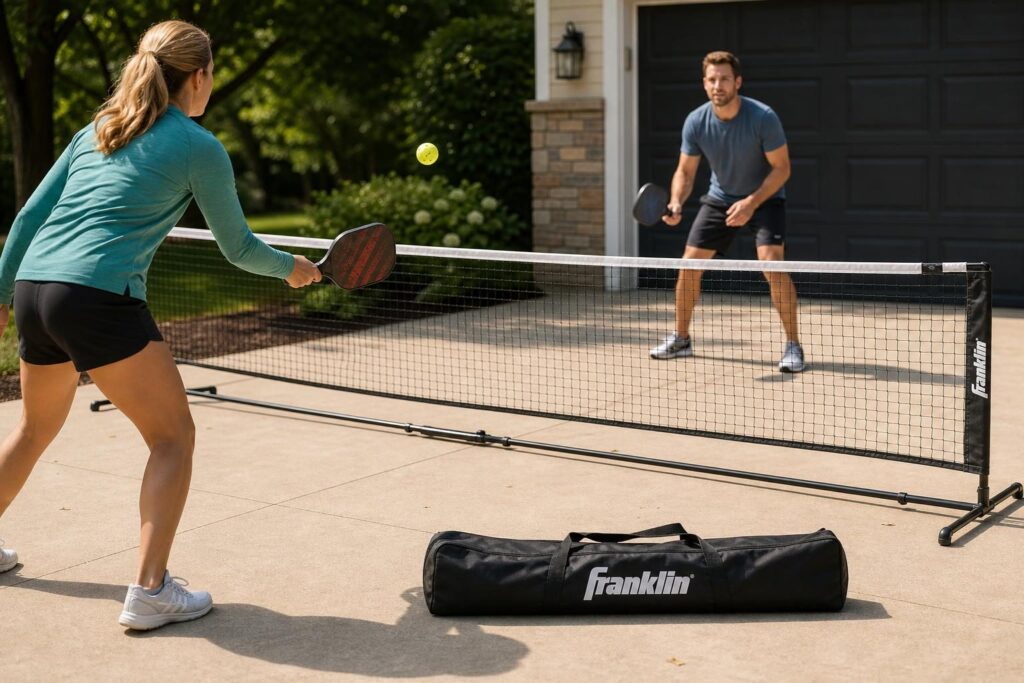
Franklin Sports offers portable pickleball nets in different configurations, making it a useful brand to compare when keeping the initial purchase manageable is a priority. Be careful to distinguish full-court nets from shorter practice versions.
This is a good starting point for families trying pickleball at home. Compare the exact frame, included bag, dimensions, and assembly requirements before deciding whether a particular listing offers good value.
Strengths
- Options for different needs: The range includes configurations aimed at different spaces and uses.
- Accessible starting point: Worth comparing for occasional driveway games and beginner practice.
- No permanent court commitment: Lets a household try a temporary setup before investing in more substantial equipment.
Drawbacks
- Listings require careful checking: A shorter practice net is not interchangeable with a regulation-width system.
- Features vary: Do not assume every version includes wheels, the same frame materials, or identical storage accessories.
- Lowest price is not always best value: Frequent setup can make better frame connections and easier transport worth paying for.
Best fit: Occasional players willing to compare individual configurations instead of buying on brand name alone.
JOOLA Essentials Pickleball Net: Best for a Simple Shared-Court Setup
The JOOLA Essentials pickleball net is another sensible full-size option for temporary play. It is worth considering when your main requirement is a straightforward system that can travel to a shared hard court and leave with you afterward.
For community groups, consistency matters. Keeping the complete kit together and using the same assembly routine helps reduce delays when several players are waiting.
Strengths
- Full-court purpose: A suitable category of net for standard recreational singles and doubles.
- Temporary installation: Useful where permanent net posts are unavailable or prohibited.
- Simple ownership needs: A practical candidate for players who do not need a specialized lightweight system.
Drawbacks
- Check transport specifications: A portable net can still be awkward to carry over a long distance.
- Shared equipment needs care: Missing connectors or poorly packed frame sections can interrupt the next session.
- Not a rolling court fixture: Do not assume a standard portable kit can be moved around while assembled like a purpose-built wheeled system.
Best fit: Groups looking for a straightforward temporary net for approved shared-court use.
Buying Guide: What to Look for in a Portable Pickleball Net
Choose Full-Size Dimensions for Standard Play
A regulation pickleball net should be at least 22 feet wide, with a height of 36 inches at the sidelines and 34 inches at the center. A center support helps maintain that lower middle height.
Short practice nets can be useful for drills, but they do not create a standard court. Also remember that the court itself measures 20 by 44 feet, with additional clear space needed around it for safe movement.
Match Portability to Your Routine
Check both assembled weight and packed size. A bag that fits easily in a garage may be awkward in a small vehicle or on a long walk to the court.
- Frequent carrying: Prioritize lower weight and a manageable bag.
- Occasional driveway use: A conventional frame may be perfectly adequate.
- Moving an assembled net: Look specifically for a system designed with wheels rather than dragging a standard frame.
Look Beyond the Net Fabric
Frame connections, support feet, tension adjustment, and the center support all affect usability. Check whether replacement parts are available, especially if the net will be shared by a group.
A portable system will not feel identical to a permanently installed net. The goal is consistent height, reasonable tension, and a stable setup—not simply the tightest possible top band.
Check the Playing Surface and Storage Plan
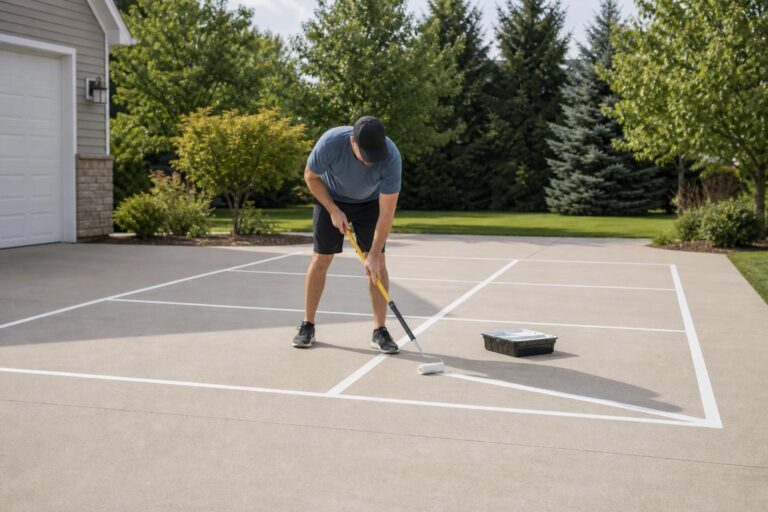
A sloping driveway affects both footing and ball bounce. Avoid active vehicle areas, cracks that create trip hazards, and layouts that force players toward walls or parked cars. Get permission before setting up on shared courts.
Pack the net away dry whenever possible, and store it out of prolonged sun and rain. Follow the manufacturer’s wind guidance, and stop play if the system becomes unstable.
Conclusion
The best portable pickleball nets fit both your playing space and your setup routine. SwiftNet deserves attention for frequent transport, while PickleNet, ONIX, Franklin Sports, and JOOLA offer useful alternatives for conventional recreational setups. Compare the exact dimensions, carrying weight, frame design, and included accessories before choosing.