How Much Space Do You Need for a Backyard Pickleball Court?
This article contains affiliate links. If you buy through them, we may earn a commission at no extra cost to you.
The space needed for a backyard pickleball court is larger than the painted court itself. The playing lines measure 20 by 44 feet, but you also need clear space around them to move, stop, and retrieve shots. These frequently asked questions will help you measure your yard, compare layout options, and decide whether a full-size court is practical.
This article is part of our guide: Home Pickleball Court Setup Guide: Space, Surfaces, Nets, and Balls
Backyard Pickleball Court Dimensions
1. What are the dimensions of a regulation pickleball court?
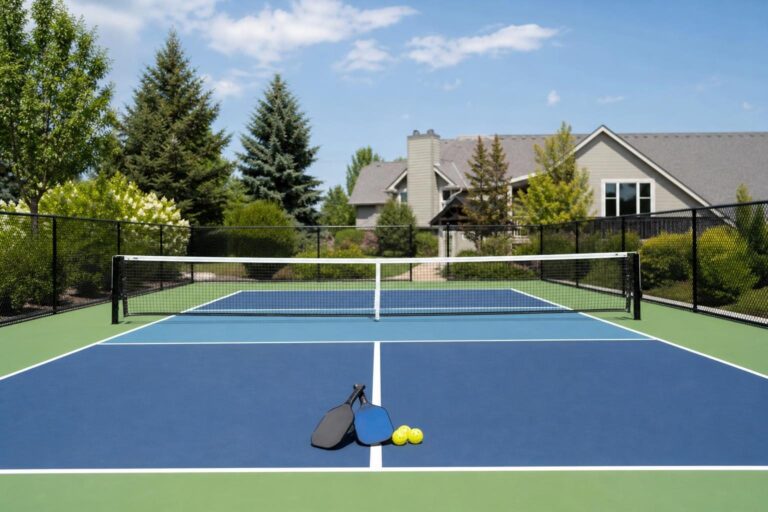
A regulation pickleball court measures 20 feet wide by 44 feet long, including the boundary lines. The same court dimensions apply to singles and doubles.
Those measurements describe only the marked playing area, not the entire surface you should build. Players regularly move beyond the sidelines and baselines during normal play.
The court also includes a non-volley zone, commonly called the kitchen, extending 7 feet from the net on each side. The remaining area between each kitchen line and baseline is divided into two service courts.
- Marked court: 20 by 44 feet.
- Area inside the court boundaries: 880 square feet.
- Net height: 36 inches at the sidelines and 34 inches at the center.
When checking whether a court will fit, start with the full playing surface rather than the 880-square-foot rectangle alone.
2. How much total space do I need for a backyard pickleball court?
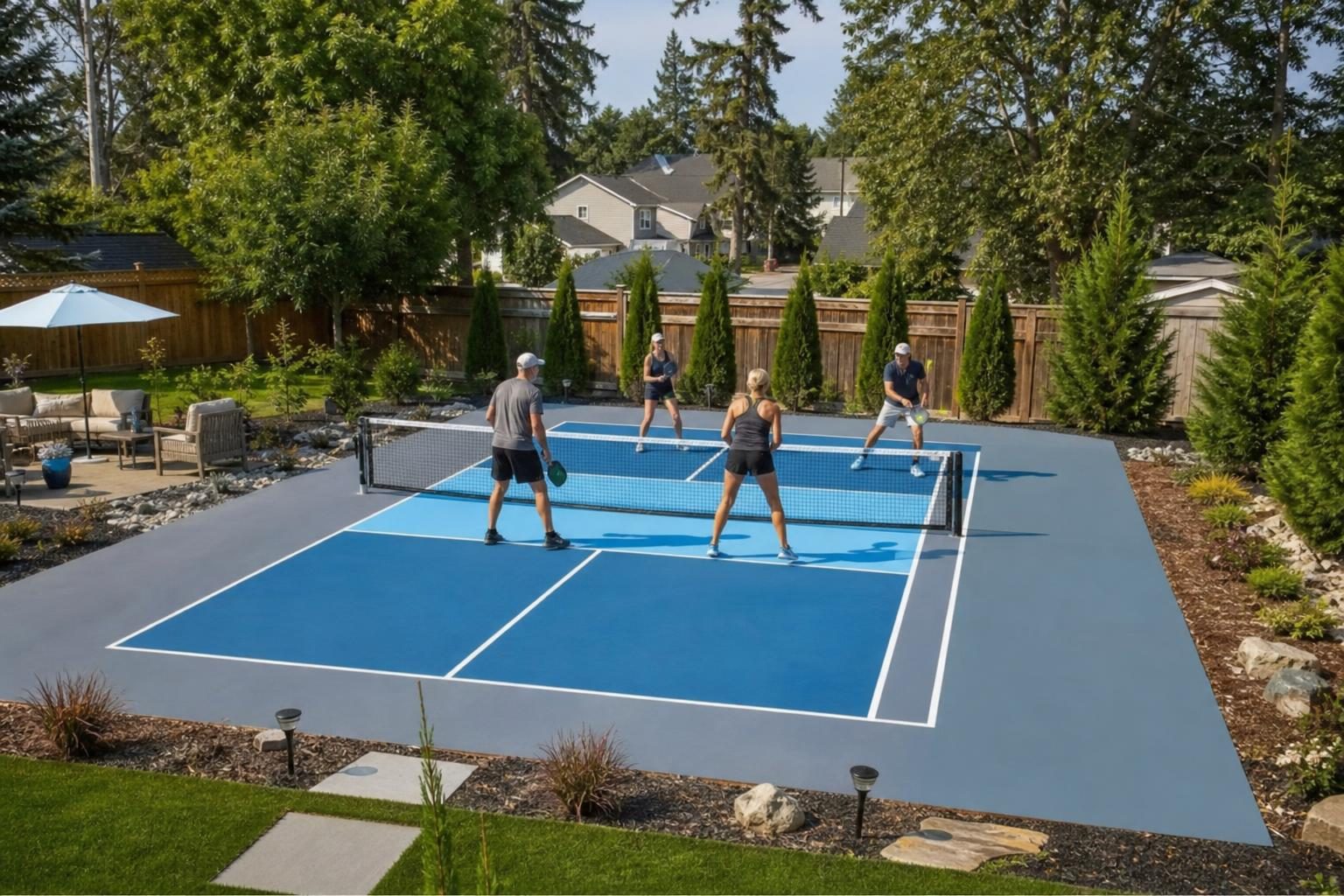
Plan for at least 30 by 60 feet of unobstructed playing surface, with 34 by 64 feet providing more comfortable clearance.
A 30-by-60-foot surface is a commonly recommended minimum. A 34-by-64-foot surface gives players more room around the boundaries and is a better planning target when your yard allows it.
| Layout | Dimensions | Total area | Clearance around a centered court |
|---|---|---|---|
| Marked court only | 20 by 44 feet | 880 square feet | No runoff space |
| Minimum recommended surface | 30 by 60 feet | 1,800 square feet | 5 feet at each side; 8 feet behind each baseline |
| Roomier surface | 34 by 64 feet | 2,176 square feet | 7 feet at each side; 10 feet behind each baseline |
These footprints do not automatically include room for landscaping, seating, drainage structures, or access paths. Your overall backyard project may need more land than the playing surface alone.
3. Can I fit a pickleball court in a smaller backyard?
You can create a smaller practice area, but a yard that cannot accommodate adequate runoff is not a good fit for a full regulation playing layout.
Simply squeezing 20-by-44-foot lines between a house and a fence leaves no room to chase balls safely. A patio edge, retaining wall, or garden bed immediately outside a baseline can become a collision or tripping hazard.
If a full layout will not fit, consider:
- A shortened practice court for casual games with modified rules.
- A compact net setup for dinking and controlled volley drills.
- A suitable practice wall with a clear approach area.
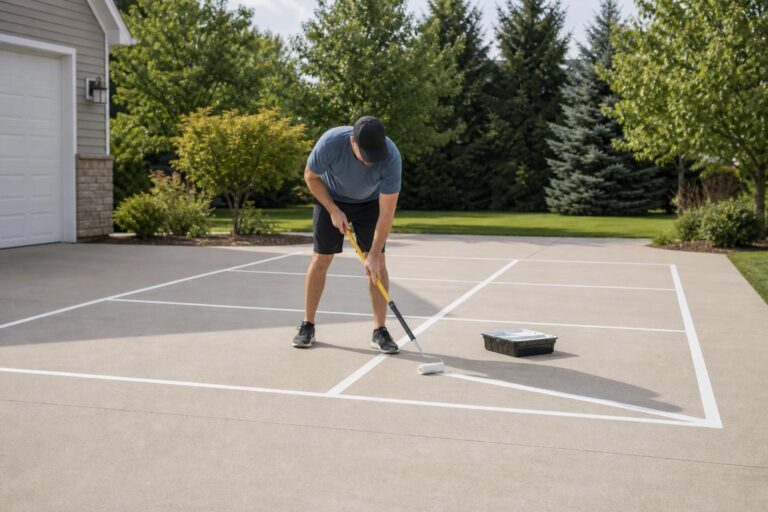
- Removable lines on an existing multipurpose paved area.
Keep any reduced-size setup clearly separate from a regulation court in your expectations. It can still be useful for skill development, but it will not reproduce normal serving distances or full-court movement.
4. Can I use my driveway or patio for a pickleball court?
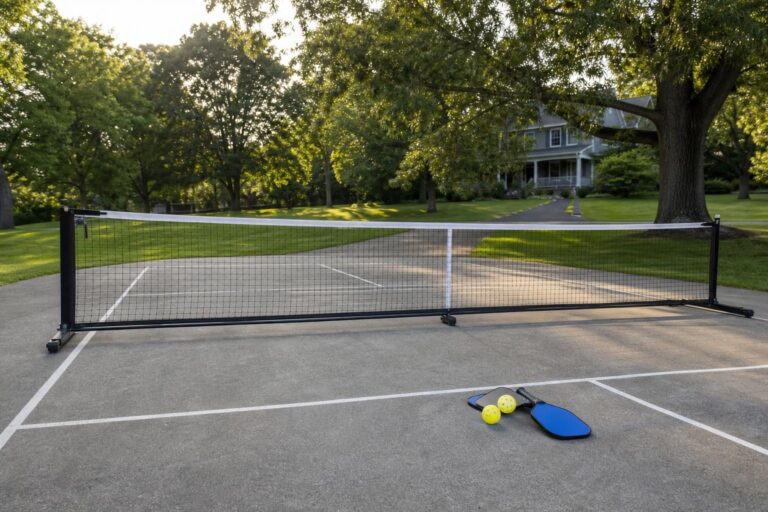
You can use a driveway or patio if it provides enough continuous, unobstructed space and a suitable surface for safe movement.
Measure the usable area, not just the overall paved dimensions. Parked cars, steps, garage doors, basketball posts, and drainage channels can reduce the space available.
Before adding temporary lines and a portable net, check for:
- Surface problems: Loose gravel, slippery finishes, raised joints, or significant cracks.
- Excessive slope: A steep driveway can affect footing and ball behavior.
- Nearby hazards: Traffic, windows, doorways, and abrupt pavement edges.
- Net placement: Portable net feet must not create avoidable trip hazards.
A driveway that is too small for full games may still work for controlled practice. Keep play away from vehicle access and public traffic.
5. Does a singles pickleball court need less space than a doubles court?
No, regulation singles pickleball uses the same 20-by-44-foot court as doubles and still needs clearance around the boundaries.
Having fewer players does not eliminate the need for runoff. Singles players may cover substantial ground while retrieving wide or deep shots.
If you have heard of “skinny singles,” that is a modified game using only part of the court. It can suit a narrower practice setup, but it does not change the dimensions required for regulation singles play.
Planning the Space Around Your Court
6. How much overhead clearance does a backyard pickleball court need?
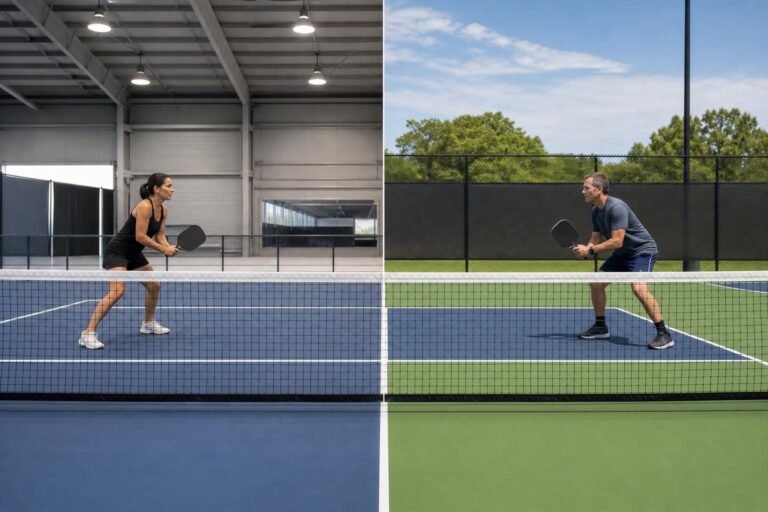
A backyard court needs clear overhead space for lobs, with no branches, wires, or structures interfering with play.
For an open-air court, inspect the entire area above both the marked court and the surrounding runoff. A branch above the baseline can interfere with a lob even when the center of the court is completely open.
If you are considering a roof, pavilion, or other covered structure, have the designer verify appropriate sports clearance and local building requirements. Low ceilings and crossbeams can make an otherwise full-size layout unsuitable for normal play.
Do not plan construction near overhead utility lines without involving the relevant utility provider and qualified professionals.
7. How much extra room should I allow for fences, net posts, and seating?
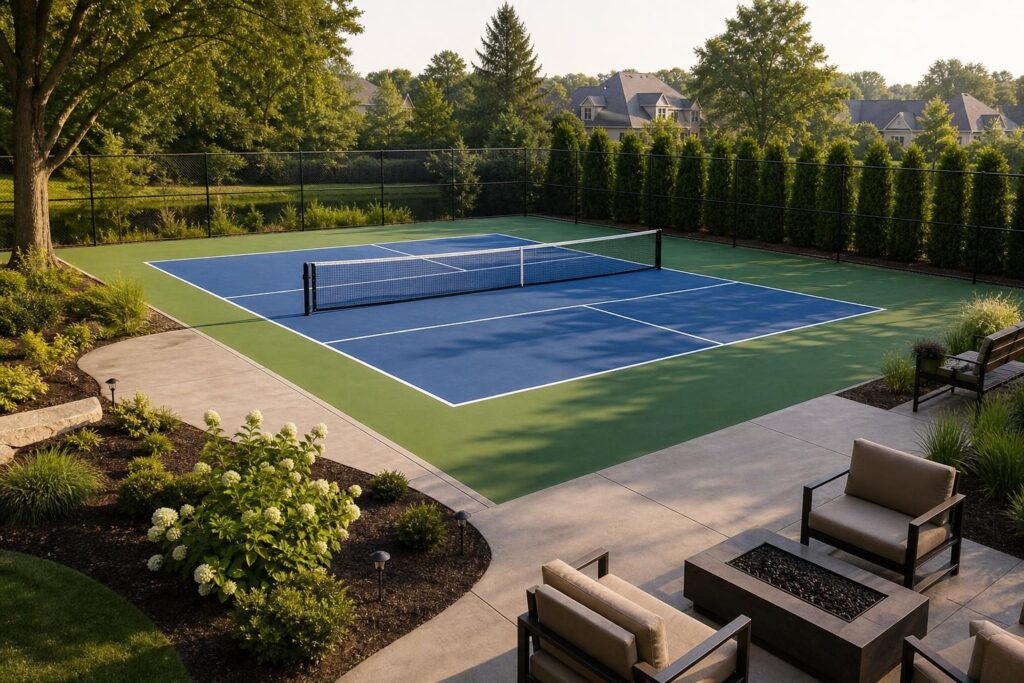
Place fences, seating, and other fixed features outside the clear playing envelope, and account separately for their installation space.
A fence should not sit directly on a sideline or baseline. The space between the court lines and perimeter obstacles is where players slow down and recover shots.
Plan the surrounding features carefully:
- Fencing: Keep posts, footings, gates, and protruding hardware out of player movement areas.
- Net equipment: Confirm post locations and foundation requirements before pouring the slab.
- Seating: Put benches and chairs beyond the clear playing surface.
- Lighting: Position poles outside runoff areas and have the lighting layout professionally designed.
- Access: Leave a practical route for players, maintenance, and any accessibility requirements that apply.
If your available yard measures exactly 30 by 60 feet, do not assume every accessory will fit within that footprint without compromising clearance.
8. Which direction should a backyard pickleball court face?
A roughly north–south court orientation is generally preferred because it helps reduce direct low-angle sunlight in players’ eyes.
It is a planning preference, not a guarantee of glare-free play. Your latitude, surrounding trees, buildings, and usual playing times all affect sun exposure.
Before choosing the layout, visit the proposed location during the hours you expect to play. Check whether one end faces strong morning or evening sun.
Balance orientation against other practical needs. A north–south layout is not worth sacrificing safe runoff, necessary setbacks, or workable drainage.
9. Does the ground need to be completely level?
A pickleball court needs a smooth, consistent surface, but an outdoor court generally requires a slight designed slope for drainage rather than being perfectly level.
The goal is a predictable playing surface that sheds water without noticeable dips, humps, or abrupt changes in grade. Poor drainage can leave puddles, encourage slippery growth, and contribute to surface deterioration.
A qualified court contractor should assess:
- Existing grades and soil conditions.
- Excavation and base preparation needs.
- The appropriate drainage slope and direction.
- Where runoff will go without causing problems for buildings or neighboring properties.
A sloping backyard may still accommodate a court, but grading, retaining structures, and drainage work can expand the project well beyond the visible court footprint.
10. Do property setbacks or permits affect how much space I need?
Yes, local setbacks, permits, easements, and neighborhood rules can reduce the portion of your yard available for a court.
A backyard may look large enough while still having restrictions that prevent your preferred layout. Requirements vary by location, so check before committing to construction.
Ask your local planning or building office about paved surfaces, drainage, fences, retaining walls, and lighting. If applicable, review homeowners association rules as well.
Also confirm property boundaries and utility locations. Do not assume an existing fence marks the legal property line.
Finally, consider nearby homes. Pickleball sound and nighttime lighting can affect neighbors, and any planned screening or sound-control measures may need additional space and approvals.
Conclusion
For a backyard pickleball court, start with a 30-by-60-foot clear playing surface and aim for 34 by 64 feet when possible. Then allow for accessories, access, drainage, and local restrictions. Measuring the complete usable footprint—not just the painted lines—is the best way to plan a court that fits your yard and supports comfortable play.