Indoor vs. Outdoor Pickleballs: How Construction Affects Play
This article contains affiliate links. If you buy through them, we may earn a commission at no extra cost to you.
The difference between indoor vs outdoor pickleballs goes beyond where you play. Hole size, plastic formulation, weight, and stiffness all influence how a ball travels, bounces, and responds to your paddle. Choosing the right type can make rallies more predictable and help you practice with equipment that suits your court.
This article is part of our guide: Home Pickleball Court Setup Guide: Space, Surfaces, Nets, and Balls
Indoor vs Outdoor Pickleballs: Key Differences
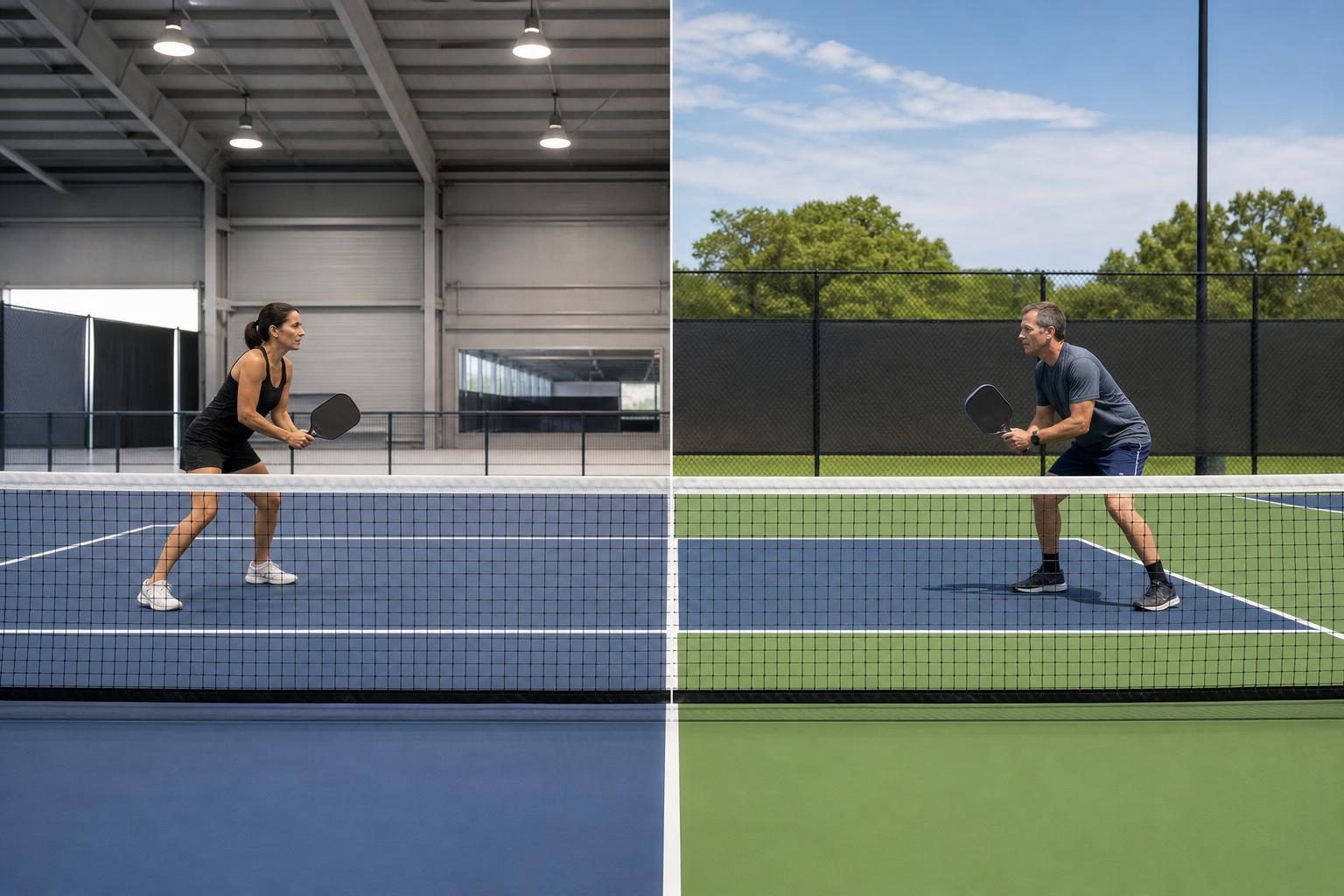
Both types are hollow plastic balls with holes, but they are generally designed for different playing conditions. Indoor models typically suit smooth gym floors and still air. Outdoor models are usually built for hard courts, wind, and more abrasive surfaces.
These are common design patterns rather than universal rules. Individual models vary, and the best choice depends on the court surface as well as whether there is a roof overhead.
| Feature | Indoor Pickleballs | Outdoor Pickleballs |
|---|---|---|
| Hole pattern | Typically fewer, larger holes; commonly 26 | Typically more, smaller holes; commonly 40 |
| Plastic and stiffness | Usually softer and more flexible | Usually harder and more rigid |
| Weight | Often slightly lighter | Often slightly heavier |
| Typical playing surface | Wood or synthetic gym flooring | Textured asphalt, concrete, or acrylic-coated courts |
| Playing feel | Often softer off the paddle, with a more controlled feel | Often firmer and livelier off the paddle |
| Wind performance | Generally more easily disrupted outdoors | Generally better suited to outdoor airflow |
| Common wear | Scuffing, softening, or loss of shape | Surface abrasion, cracking, or loss of shape |
| Typical best fit | Recreation centers and indoor gym sessions | Outdoor courts and indoor facilities with outdoor-style surfaces |
Indoor Pickleballs: Construction and Playing Characteristics
Fewer, Larger Holes
Indoor pickleballs commonly have 26 relatively large holes. This familiar pattern is a useful identification clue, although hole count alone does not tell you everything about a ball’s performance.
Hole size and placement influence airflow around and through the ball. Combined with the ball’s weight and surface, they affect drag and flight. Indoor designs work well in the relatively stable conditions of a gym, where gusts are not constantly changing a shot’s path.
Softer Plastic and a Gentler Feel
Indoor balls generally use a softer, more flexible plastic than outdoor balls. They often feel less sharp at paddle contact, which some recreational players find comfortable during controlled rallies.
That does not mean an indoor ball automatically creates better touch. Your paddle, contact point, and swing still matter far more. However, switching from a firm outdoor ball to a softer indoor model can noticeably change how much effort you need for a dink, block, or deep return.
Performance on Gym Floors
Wood and synthetic gym floors interact with a ball differently from textured outdoor courts. Their smoother surfaces can change how shots bounce and skid, particularly when dust is present.
An indoor ball is generally the sensible starting point for these facilities. Check what the venue or regular playing group uses, because consistent equipment helps everyone judge the bounce and pace.
Advantages and Limitations
- Good fit for gym play: Indoor construction is typically suited to smooth flooring and sheltered conditions.
- Softer contact: Players who prefer a less rigid feel may enjoy the response.
- Less suitable for wind: A lighter indoor model can be harder to manage outside.
- Not immune to wear: Softer balls can deform or lose their preferred playing characteristics even without obvious cracks.
Outdoor Pickleballs: Construction and Playing Characteristics
More, Smaller Holes
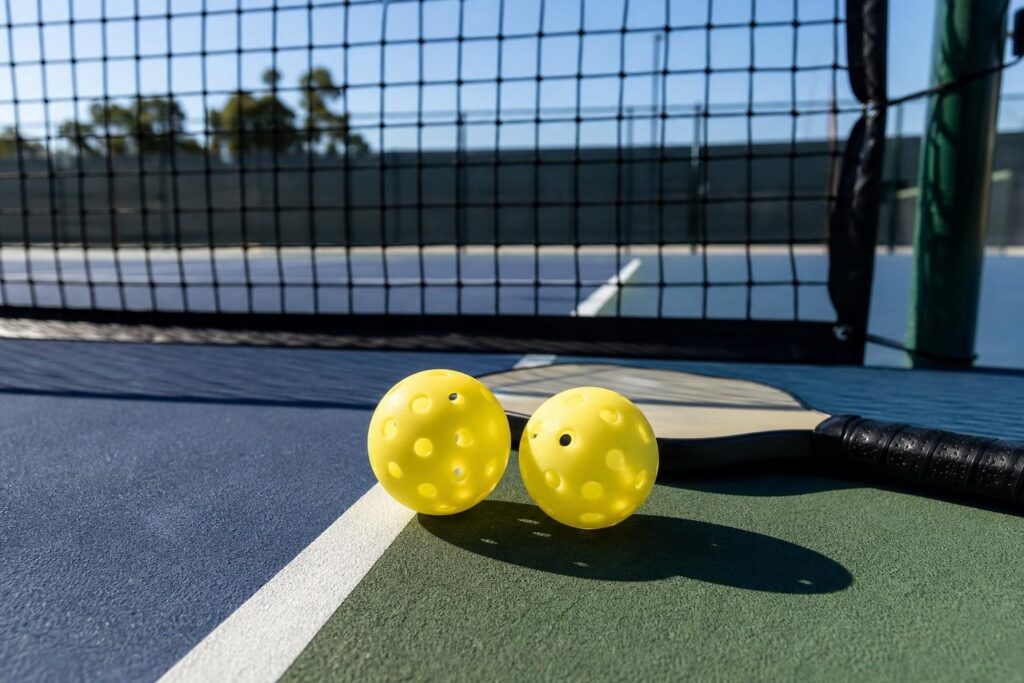
Outdoor pickleballs commonly have 40 smaller holes. Along with the rest of the construction, this pattern helps produce flight characteristics suited to open-air courts.
Do not mistake that for wind resistance in the everyday sense of being unaffected by gusts. Every pickleball can drift, dip, or carry in moving air. Outdoor models simply tend to be the more practical choice when conditions are exposed.
Harder Plastic and Firmer Contact
Outdoor balls generally have a more rigid shell and are often slightly heavier than indoor models. They usually feel firmer against the paddle and can produce a faster, crisper response.
This matters during quick exchanges at the kitchen line. Blocks may rebound differently, and a shot that stays controlled with one ball may travel too far with another. Allow a few minutes of warm-up when changing ball types rather than assuming your usual swing will produce the same result.
Hardness does not determine bounce by itself. Wall thickness, material formulation, temperature, and the court surface all contribute to what happens after the ball lands.
Durability on Rough Courts
Outdoor court texture abrades the ball during normal play. Scuffs are expected, but cracks, uneven shape, or an inconsistent bounce are reasons to replace it.
A harder shell is not a guarantee of a longer lifespan. Some rigid balls can crack, particularly in cold conditions. Heat can soften plastic and change how a ball responds, so a model that feels right in mild weather may behave differently during a hot afternoon.
Advantages and Limitations
- Better fit for exposed courts: Outdoor models are generally more suitable for wind and hard-court play.
- Firmer response: They support the crisp feel familiar at many dedicated pickleball facilities.
- Useful for competition preparation: Practicing with the event’s chosen ball reduces one source of adjustment.
- Temperature-sensitive performance: Cold and heat can affect feel, shape, and durability.
Why Court Surface Matters More Than the Roof
One of the most useful lessons in comparing indoor vs outdoor pickleballs is that “indoors” does not always mean “use an indoor ball.” Many dedicated indoor facilities have textured, acrylic-coated courts similar to outdoor courts.
Those facilities often use outdoor-style pickleballs because the surface and desired playing response call for them. By contrast, a school gym with a polished wood floor will usually be a better match for an indoor ball.
Before buying, ask the facility which type it recommends. For organized play, follow the league or event requirements, including any specified model and approval requirements.
Which Should You Choose?
For Gym and Recreation-Center Players
Choose an indoor pickleball if you mainly play on wood or smooth synthetic gym floors. Confirm the local preference before buying a large pack, especially if you join established open-play sessions.
For Outdoor Recreational Players
Choose an outdoor pickleball for dedicated outdoor courts. Its typical construction is better suited to the surface and weather. Start with a small quantity so you can assess visibility, feel, and how well it holds up in your conditions.
For Players at Dedicated Indoor Facilities
Choose the facility’s standard ball. If the courts have an outdoor-style textured finish, an outdoor model will often be the right option despite the indoor location.
For Tournament and League Players
Choose the exact ball specified for your competition. Two outdoor models can differ enough in stiffness, bounce, and pace to require adjustment. Matching the event ball makes practice more relevant than choosing solely by category.
For Beginners
Choose for your regular court, not your skill level. An indoor ball is not automatically a beginner ball, and an outdoor ball is not reserved for advanced players. Learning with the ball used by your local group is the more useful approach.
For Players Who Use Both Court Types
Keep a small supply of each type. Separate them in your bag and check them before play. Replace balls that are cracked, visibly misshapen, or bouncing irregularly, and store them away from prolonged heat and direct sunlight.
Conclusion
Indoor and outdoor pickleballs use different combinations of hole patterns, plastic stiffness, and weight to suit different conditions. Start with the playing surface, check your venue’s preference, and match the competition ball when needed. The right choice is the one that gives you a consistent response on the courts you actually use.